Imtroduction
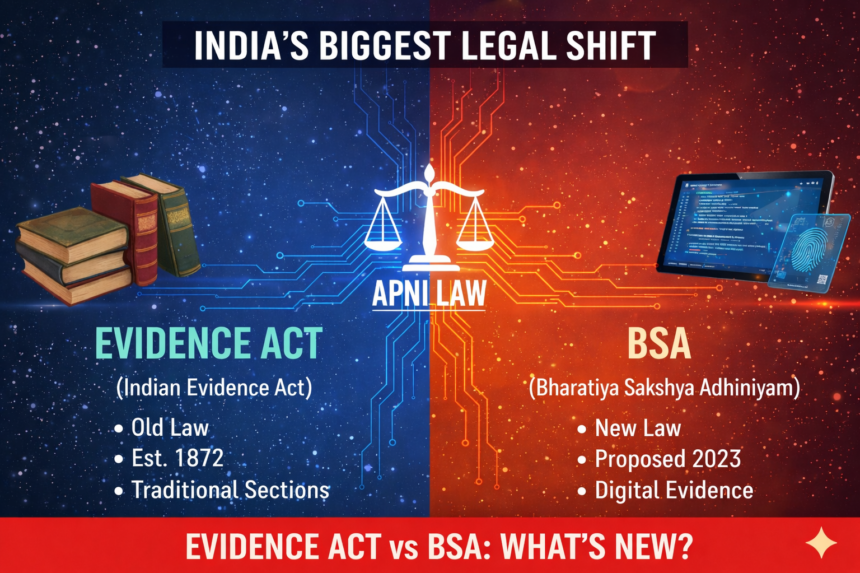
Indian evidence law clearly recognises handwriting and signature proof as a crucial part of document authentication. Courts often face disputes about who wrote or signed a document. To resolve this, the law allows opinions from people who are familiar with a person’s handwriting or signature. This principle existed under the Indian Evidence Act, 1872, and continues unchanged under the Bharatiya Sakshya Adhiniyam, 2023.
Both laws rely on the same idea. A person who has regularly seen another individual write or sign can help the court form an opinion. The law does not restrict this power to experts alone. Ordinary witnesses with genuine familiarity can also assist the court.
What Does Section 47 of the Indian Evidence Act Say?
Section 47 of the Indian Evidence Act, 1872 deals with opinions on handwriting and signatures. It states that when a court must decide who wrote or signed a document, the opinion of a person acquainted with that handwriting or signature becomes relevant.
The section focuses on acquaintance. The witness must have direct and personal familiarity. This familiarity may arise from seeing the person write, receiving documents written by them, or engaging in business where their handwriting was routinely used. Courts have consistently accepted this approach.
Judicial decisions confirm that Section 47 applies to both handwriting and signatures. The Supreme Court has clarified that the provision does not draw a distinction between writing content and signing a document. Both fall within the same evidentiary framework.
How Does a Witness Become “Acquainted” With Handwriting?
Acquaintance under Section 47 must rest on real interaction. A witness must have seen the person write or sign. Alternatively, the witness may have received letters or documents written by that person in the ordinary course of life or business. Repeated exposure creates familiarity.
Courts reject casual or artificial familiarity. A witness cannot claim acquaintance merely by comparing disputed writing with admitted samples in court. Hearsay knowledge also fails the test. The law insists on natural and prior familiarity, not knowledge gained for litigation.
This strict requirement protects the reliability of lay opinions. It ensures that courts do not rely on speculative or manufactured evidence.
Why Was Section 47 Important in Judicial Practice?
Section 47 played a supporting role in proving documents. Courts treated it as one of several methods to establish authorship. A party could rely on admission by the writer, testimony of an eyewitness, expert opinion under Section 45, or opinion evidence under Section 47.
Judges often cautioned against relying solely on lay opinion. They preferred corroboration through other evidence. Still, when properly founded, Section 47 evidence carried significant weight.
Case law repeatedly emphasised that the value of such evidence depends on the quality of acquaintance, not the status of the witness.
What Is Section 41 of the Bharatiya Sakshya Adhiniyam, 2023?
Section 41 of the Bharatiya Sakshya Adhiniyam, 2023 replaces Section 47 of the Indian Evidence Act. The new provision came into force on 1 July 2024. Its language mirrors the old section word for word.
The section states that when a court has to form an opinion about who wrote or signed a document, the opinion of a person acquainted with that handwriting or signature is a relevant fact. The continuity is complete.
The legislature made a conscious choice to retain the same rule. This ensures stability and predictability in evidentiary law.
Does Section 41 BSA Change the Legal Position?
Section 41 of the BSA introduces no substantive change. It preserves the same scope, meaning, and application as Section 47 of the IEA. Courts will interpret it using the same principles developed over decades.
The requirement of personal acquaintance remains unchanged. The section continues to apply to both handwriting and signatures. It also continues to function alongside expert evidence under Section 39 of the BSA, which replaces Section 45 of the IEA.
The transition affects only the statute name and numbering. The evidentiary value stays the same.
How Do Courts Use Lay Opinion Alongside Expert Evidence?
Courts do not treat lay opinion as a substitute for expert evidence. Instead, they see it as complementary. Expert handwriting analysis brings technical skill. Lay opinion brings familiarity born from daily interaction.
Judges weigh both forms of evidence carefully. If a witness shows strong and consistent acquaintance, courts may rely on their testimony. If acquaintance appears weak or doubtful, courts reject it.
Judicial practice shows a preference for multiple forms of proof. Courts rarely decide handwriting disputes on a single type of evidence.
Which Law Applies to Ongoing and Future Cases?
The timing of the proceeding decides the applicable law. Section 47 of the Indian Evidence Act applies to cases governed by the old statute. Section 41 of the Bharatiya Sakshya Adhiniyam applies to proceedings after 1 July 2024.
Despite this shift, lawyers and judges can rely on the same precedents for interpretation. Earlier case law under Section 47 remains relevant for Section 41.
This seamless transition prevents confusion and ensures continuity in trial practice.
Conclusion
Continuity protects legal certainty. Lawyers, judges, and litigants already understand how handwriting evidence works. By retaining the same rule, the BSA avoids unnecessary disruption.
The unchanged provision reinforces the balance between expert skill and human familiarity. It recognises that everyday interaction often provides reliable knowledge of handwriting.
Section 41 of the BSA confirms that modernisation of evidence law does not mean abandoning tested principles. Instead, it preserves what already works while updating the legal framework.