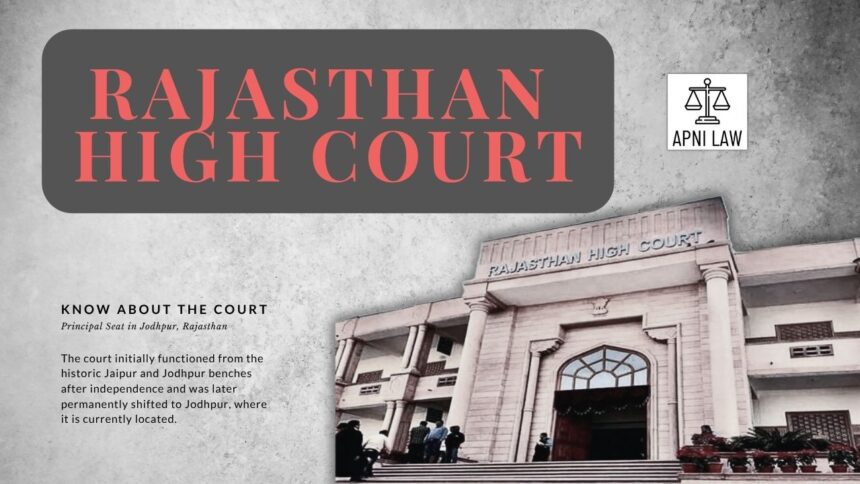
Introduction
The Rajasthan HC Court held that a husband’s conviction and sentence for cheque dishonour do not automatically justify quashing proceedings against his wife for a separate security cheque issued as guarantor.
Background
The Rajasthan High Court has held that proceedings under Section 138 of the Negotiable Instruments Act, 1881, cannot be quashed merely because the accused issued a security cheque as a guarantor for a loan borrowed by her husband, who had already been convicted in connection with the same transaction.
Justice Sunil Beniwal observed that a guarantor’s cheque is not excluded from the scope of Section 138 merely because the underlying transaction involved the principal debtor. The Court also clarified that the possibility of double recovery does not automatically extinguish proceedings arising from a separate dishonoured cheque.
The case arose when the petitioner’s husband borrowed money from the complainant and issued a cheque towards the transaction. The petitioner stood as guarantor and issued a separate cheque for the loan amount as security. Both cheques were dishonoured, prompting the complainant to initiate a joint complaint against them.
During the proceedings, the petitioner shifted to her maternal home following matrimonial discord. As she did not receive notice there, she failed to appear before the trial court and was declared an absconder. After learning of her husband’s conviction and sentence, she surrendered before the trial court and obtained bail. She subsequently approached the High Court seeking relief from the proceedings.
Legal Issue
The principal issue was whether a guarantor could face prosecution under Section 138 of the Negotiable Instruments Act for a dishonoured security cheque when the principal debtor had already been convicted and served his sentence in connection with the same transaction.
The Court also considered whether the petitioner’s status as a guarantor, the security nature of her cheque and the possibility of recovering the same debt twice justified quashing the proceedings.
Court Ruling
The High Court relied on the Supreme Court’s decision in ICDS Ltd. v. Beena Shabeer, which recognised that a cheque issued by a guarantor may fall within the scope of Section 138 of the Negotiable Instruments Act. The Bench held that a guarantor’s status alone does not provide a ground to quash proceedings when the cheque issued by the guarantor has been dishonoured. The statutory provision covers cheques issued in respect of legally enforceable debts or other liabilities, subject to fulfilment of its requirements. The Court rejected the argument that the husband’s conviction and sentence meant that the complainant’s only remaining remedy was a civil suit. It distinguished criminal liability arising from cheque dishonour from the recovery of the underlying debt. The Bench observed that the husband’s incarceration did not establish that the complainant had received payment or recovered the amount due. However, it clarified that the complainant could not recover the same debt more than once. Any amount actually recovered towards the underlying liability would have to be accounted for in accordance with law.
The Court further noted that the proceedings against the petitioner had reached an advanced stage. Questions concerning the nature of the transaction, the purpose of the cheque and the existence of a legally enforceable liability could be examined by the trial court on the basis of the evidence.
Accordingly, the High Court dismissed the petition, leaving the disputed factual questions to be considered in the ongoing proceedings.
Implications
The ruling clarifies that a guarantor may face proceedings under Section 138 of the Negotiable Instruments Act for a dishonoured cheque, even when the principal debtor has already been convicted in connection with the same transaction. The security nature of the cheque does not, by itself, exclude the provision’s application.
At the same time, the judgment distinguishes prosecution for cheque dishonour from recovery of the underlying debt. While separate proceedings may continue in relation to separate dishonoured cheques, the complainant cannot recover the same debt more than once.
The judgment adds clarity on the potential liability of guarantors under cheque-dishonour law and the need to account for any amounts already recovered towards the underlying obligation.