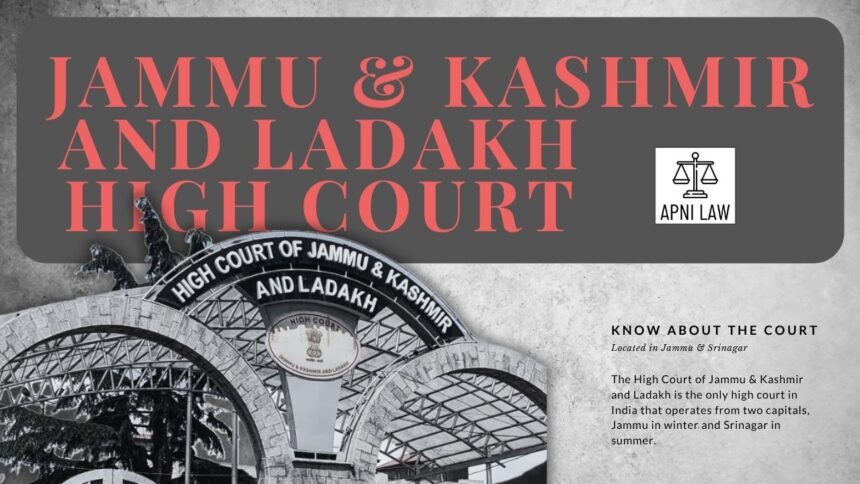
Introduction
The Jammu & Kashmir and Ladakh High Court has held that merely using a forged document as genuine does not establish an offence under Section 471 of the Ranbir Penal Code (RPC). The prosecution must also establish that the accused knew or had reason to believe that the document was forged and used it fraudulently or dishonestly.
Background
The case arose from a recruitment drive conducted in 2011 to select constables for the Jammu & Kashmir Police. Ankush Sharma was among 173 candidates selected for the drive in Tehsil Akhnoor.
During document verification, Sharma’s Permanent Resident Certificate was allegedly found to be forged. The discovery led to the registration of an FIR at Police Station Akhnoor for offences under Sections 420, 467, 468 and 471 of the RPC.
According to the prosecution, Sharma’s maternal grandmother, Shanti Devi, had approached Patwari Ravi Singh and allegedly procured the certificate in Sharma’s favour in connivance with him. The investigation attributed the preparation of the forged certificate to these individuals, both of whom subsequently died.
The investigation also revealed that Sharma was only 13 years old when the certificate was prepared. Records indicated that his maternal grandmother had taken him in adoption and raised him as her son at Akhnoor. She was herself a permanent resident of Jammu & Kashmir.
The Sessions Court found that only the offence under Section 471 RPC was made out against Sharma. He challenged the order before the High Court, arguing that there was no material showing that he had participated in preparing the forged certificate or knew that it was not genuine.
Legal Issue
The primary issue before the High Court was whether producing a forged Permanent Resident Certificate before a recruitment authority was sufficient to attract Section 471 RPC when there was no evidence that the accused knew or had reason to believe that the document was forged.
The Court also examined the meaning of “reason to believe” and whether the circumstances of Sharma’s upbringing and age when the certificate was prepared supported an inference that he knew about the alleged forgery.
Court Ruling
Justice Sanjay Dhar held that the use of a forged document as genuine does not, by itself, establish an offence under Section 471 RPC. The prosecution must establish the necessary mental element, namely that the accused knew or had reason to believe that the document was forged and used it fraudulently or dishonestly.
The Court identified four essential ingredients of the offence: the document must be forged; the accused must have used it as genuine; the accused must have known or had reason to believe that it was forged; and the use must have been fraudulent or dishonest.
Relying on the Supreme Court’s judgment in A.S. Krishnan v. State of Kerala, (2004) 11 SCC 576, the High Court explained that “reason to believe” requires more than suspicion or doubt. It must arise from circumstances that provide sufficient grounds for a reasonable person to conclude, through probable reasoning, that the document is forged.
The Court found no evidence linking Sharma to the preparation of the forged certificate. The investigation had attributed the alleged forgery to his maternal grandmother and the Patwari. Although the material showed that Sharma had produced the certificate before the recruitment authority, the Court held that this fact alone did not establish the remaining ingredients of Section 471 RPC.
The respondents argued that Sharma ought to have known that he was not a permanent resident of Jammu & Kashmir because his father belonged to Rajasthan. The Court rejected this argument after considering the circumstances of Sharma’s upbringing.
The record indicated that Sharma had been raised by his maternal grandmother at Akhnoor, where she treated him as her son. Since she was a permanent resident of Jammu & Kashmir, the Court found no sufficient basis to conclude that Sharma had reason to doubt his own residential status or the genuineness of the certificate obtained in his favour.
The Court also considered that Sharma was only 13 years old when the certificate was prepared. In the circumstances of the case, it held that the essential requirement of knowledge or reason to believe that the certificate was forged had not been established.
Accordingly, the High Court held that the charge under Section 471 RPC was groundless. It set aside the order framing charges and quashed the challan and all proceedings arising from it.
Implications
The judgment clarifies that the use of a forged document does not automatically establish criminal liability under Section 471 RPC. The prosecution must establish not only that the document was forged and used as genuine, but also that the accused possessed the required knowledge or reason to believe that it was forged and used it fraudulently or dishonestly.
The ruling also distinguishes actual knowledge from suspicion. A person’s use of a document cannot, without consideration of the surrounding circumstances, automatically establish that they knew it was forged.
The decision highlights the importance of examining the accused’s age, background and knowledge when determining whether the required mental element exists. However, the finding was based on the particular facts and evidence in Sharma’s case and does not create a general exemption from liability for every person who uses a forged document without personally preparing it.
The judgment adds clarity on the distinction between using a forged document and knowingly using it as genuine, reaffirming that the prosecution must establish the essential ingredients of the alleged offence before criminal charges can proceed.
Case Title: Ankush Sharma v. U.T. of J&K and Another