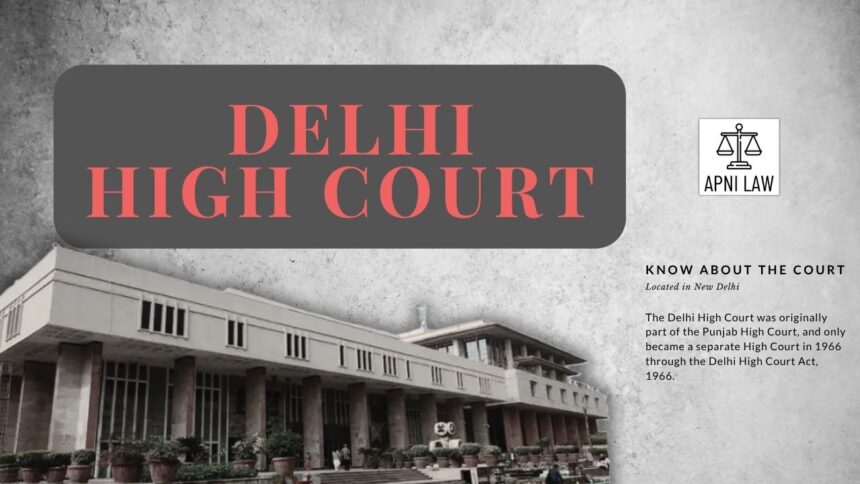
Introduction
The Delhi High Court has held that the statutory one-year waiting period for filing a divorce petition under the Special Marriage Act, 1954, can be waived in exceptional cases where continuing the marriage would only prolong the parties hardship. The Court observed that when a marriage exists merely on paper, has never been consummated, and lacks social or familial acceptance, strict adherence to the waiting period may serve no useful purpose.
Legal Issue
The issue before the Court was whether the mandatory one-year bar under Section 29 of the Special Marriage Act and the related waiting period for mutual consent divorce could be waived in a case involving exceptional hardship and mutual agreement between the spouses to dissolve the marriage.
Background
The parties, belonging to different faiths, married under the Special Marriage Act on August 25, 2025. According to them, disclosure of the marriage resulted in serious family difficulties. The husband stated that his father suffered a medical emergency and was later diagnosed with liver failure after learning about the marriage. The wife also feared adverse consequences from her family and therefore kept the marriage concealed.
The couple never lived together, did not consummate the marriage, and had no children. They jointly sought dissolution of the marriage and requested waiver of the statutory one-year waiting period. However, the Family Court rejected the request, holding that there was no exceptional hardship and that adequate efforts had not been made to preserve the marriage.
Court’s Decision
The Delhi High Court set aside the Family Court’s order and held that the Special Marriage Act grants courts the discretion to relax statutory timelines in appropriate cases. The Court found that the facts of the case clearly established exceptional hardship.
The Bench noted that the marriage was purely notional, with no cohabitation, consummation, or social recognition. It also took into account the serious family consequences faced by the parties and observed that both spouses had mutually agreed to dissolve the marriage.
The Court held that compelling the parties to wait for another year would only extend their suffering and would be contrary to the object and purpose of the legislation. It further observed that the Family Court had adopted an unduly restrictive and technical interpretation of the law.
Accordingly, the High Court allowed the waiver application and directed the Family Court to entertain the mutual consent divorce petition without insisting on the statutory one-year waiting period.
Conclusion
The Delhi High Court reaffirmed that while statutory waiting periods under the Special Marriage Act are intended to protect the institution of marriage, courts may waive such requirements where exceptional hardship is demonstrated. The judgment highlights that procedural safeguards should not be applied rigidly when a marriage has effectively ceased to exist and both parties seek an amicable dissolution.
Case Name
SK v. KS