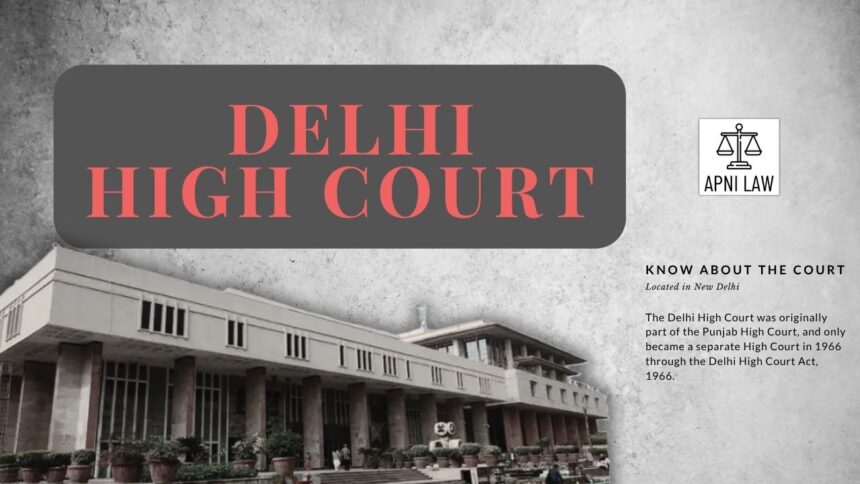
High Court rules in Urol v. Naresh, that examination of a sexual harassment complainant in the absence of the accused and without an ICC inquiry report violates civil service and natural justice norms.
New Delhi, January 7, 2026: The Delhi High Court has held that departmental disciplinary action taken against a government employee was vitiated where the internal inquiry into a sexual harassment complaint was conducted without a valid Internal Complaints Committee (ICC) report and without affording the accused a fair chance to be heard in accordance with service rules and principles of natural justice.
Court & Bench
The judgment was delivered by the High Court of Delhi, presided over by a Division Bench (names not officially reported) in a writ petition challenging disciplinary proceedings arising from allegations of sexual harassment at the workplace.
Background of the Case
The petitioner, a civil servant, faced departmental action based on a complaint alleging workplace sexual harassment. A disciplinary inquiry was initiated and progressed with examination of the complainant’s testimony. However, at a critical stage, the disciplinary authority proceeded without a formal inquiry report from the ICC constituted under the Sexual Harassment of Women at Workplace (Prevention, Prohibition and Redressal) Act, 2013 (POSH Act) and without hearing the accused.
Under civil service rules and the POSH framework, employers are mandated to constitute ICCs, inquire into complaints, and forward inquiry reports to disciplinary authorities, which then determine further action. The right to be heard and to respond to charges are recognized principles of both the service rules and the Constitution.
Legal Issue
The principal legal issue before the High Court was whether disciplinary proceedings premised on an alleged sexual harassment complaint could stand when the ICC inquiry report was absent and the accused was not given an opportunity to be heard at a stage where material findings were to be recorded.
Final Ruling
The Delhi High Court set aside the disciplinary action against the petitioner. The Court ruled that:
- The disciplinary proceedings were vitiated due to the absence of an ICC inquiry report, a mandatory step for disciplinary authority to consider allegations under POSH and relevant service rules.
- Proceeding in the accused’s absence without providing a meaningful opportunity to respond to the charge and evidence violated principles of natural justice and civil service procedural norms.
As a result, the disciplinary action and any consequent orders were quashed, and the matter was remitted for reconsideration in accordance with law.
Reasoning of the Court
The High Court emphasised that:
- For allegations of sexual harassment in service law contexts, the ICC plays a crucial role in fact-finding and issuing a report for disciplinary authorities to consider.
- The absence of a proper ICC report effectively deprived the disciplinary authority of the statutory foundation to proceed with action.
- Civil service rules and judicial precedents require that any adverse action, including examination of a complainant’s statement, must be based on a properly conducted inquiry and accompanied by an opportunity for the accused to participate meaningfully.
- Failure to allow the accused to respond to allegations or challenge evidence before adverse findings are framed constitutes a breach of principles of natural justice, warranting judicial intervention.
The Court referenced applicable statutory frameworks, including the POSH Act’s mandated inquiry procedure and broader service rule requirements.
Practical Implications
This ruling reinforces several procedural safeguards in sexual harassment and service law contexts:
- Mandatory ICC Inquiry: Disciplinary authorities must ensure that an ICC inquiry, as envisioned under the POSH Act, has been conducted and its report formally placed on record before relying on it for service-related consequences.
- Principles of Natural Justice: Accused employees must be afforded a fair hearing at all stages of disciplinary proceedings, particularly when material evidence from inquiry reports is considered.
- Service Law Compliance: Administrative and disciplinary actions stemming from sexual harassment complaints must align with service rules and statutory mandates under the POSH Act to withstand judicial scrutiny.
- Precedent for Civil Servants: The judgment may shape future challenges in service law where ICC procedures and disciplinary fairness are in question.
The decision underscores the judiciary’s emphasis on procedural regularity and fairness in workplace sexual harassment enquiries that intersect with departmental disciplinary action.
The judgment adds clarity on how disciplinary proceedings in sexual harassment cases must be grounded in a valid ICC inquiry and natural justice, reinforcing procedural protections under civil service rules and the POSH Act.