Introduction
The Court held that forgery under Section 467 IPC falls within the category of serious offences under the Juvenile Justice Act, 2015, and cannot justify transferring a juvenile’s case to the Children’s Court for trial as an adult.
Background
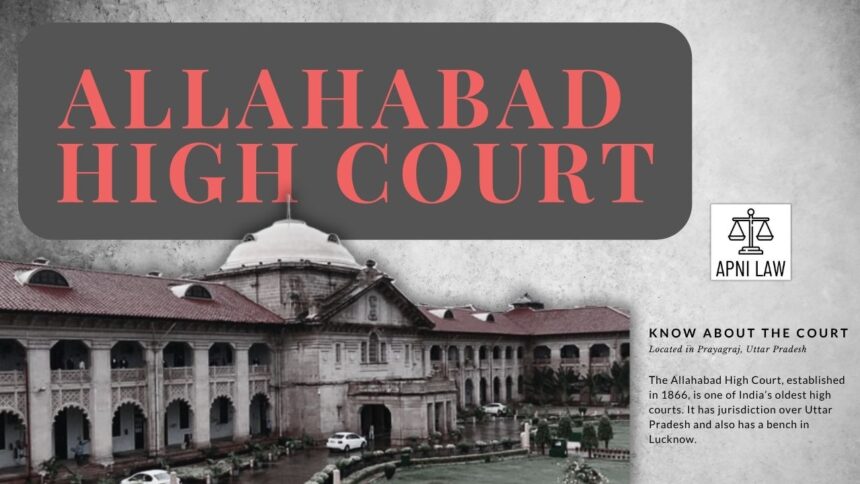
The Allahabad High Court held that an offence under Section 467 of the Indian Penal Code (IPC) cannot be classified as a “heinous offence” under the Juvenile Justice (Care and Protection of Children) Act, 2015 (JJ Act), merely because it carries a maximum sentence of life imprisonment or imprisonment extending to ten years. Justice Jai Prakash Tiwari ruled that the provision does not prescribe a minimum sentence of seven years, which is required for classification as a heinous offence under the Act.
The Court allowed a criminal revision filed by a juvenile accused in a forgery case and quashed the orders of the Juvenile Justice Board, Bulandshahr, and the Children’s Court that had upheld the transfer of the case for a possible adult trial.
The case arose from an FIR registered on June 30, 2016, following allegations of fraud and cheating involving ₹40 lakh. After investigation, a charge sheet was filed against multiple accused under Sections 419, 420, 467, 468, 471 and 120-B IPC.
The revisionist claimed that he was a juvenile when the alleged offence occurred. The Juvenile Justice Board assessed his age at 16 years, nine months and seven days at the relevant time and declared him a child in conflict with law.
On May 18, 2022, the Board conducted a preliminary assessment under Section 15 of the JJ Act and decided to transfer the case to the Children’s Court under Section 18(3), for consideration of trial as an adult. In July 2023, however, the Board classified the offence as serious rather than heinous. It later rejected the juvenile’s request for an inquiry before the Board, stating that it could not review its earlier transfer order. The Children’s Court upheld that decision on July 16, 2026.
Legal Issue
The principal issue was whether an offence under Section 467 IPC, punishable with life imprisonment or imprisonment extending to ten years and a fine but carrying no mandatory minimum sentence of seven years, could qualify as a heinous offence under Section 2(33) of the JJ Act.
The classification determines whether the Board can conduct a preliminary assessment under Section 15 and consider transferring the case to the Children’s Court under Section 18(3) for a possible adult trial.
Under Section 2(33), heinous offences are those for which the minimum punishment under the applicable law is imprisonment for seven years or more. Section 2(54) defines serious offences by reference to the prescribed punishment, including imprisonment between three and seven years.
Court Ruling
The High Court noted that Section 467 IPC concerns forgery of valuable security, a will and other specified documents. Although the provision allows life imprisonment or imprisonment for a term extending to ten years, it does not prescribe a minimum sentence of seven years.
The Bench relied on the Supreme Court’s decision in Shilpa Mittal v. State (NCT of Delhi) (2020). In that case, the Supreme Court held that offences carrying a maximum punishment exceeding seven years, but without a minimum sentence of seven years or more, cannot be classified as heinous offences under the JJ Act. Such offences are to be treated as serious offences until Parliament addresses the statutory gap.
Applying this principle, the High Court held that an offence under Section 467 IPC falls within the category of serious offences and cannot be treated as heinous under Section 2(33) of the JJ Act.
The Court also rejected the argument that the Board’s inability to review its earlier transfer order could justify continuing proceedings before the Children’s Court. It observed that procedural limitations could not validate an order made without the required statutory jurisdiction.
The Bench held that the Board lacked the authority to invoke Sections 15 and 18(3) to transfer the case for an adult trial when the alleged offence did not qualify as heinous. The Children’s Court had therefore erred in upholding the transfer.
Allowing the revision, the High Court quashed the orders passed by the Juvenile Justice Board and the Children’s Court. It remanded the matter to the Board for an inquiry under the procedure applicable to serious offences, without subjecting the revisionist to an adult trial.
Implications
The ruling clarifies that the maximum punishment prescribed for an offence does not, by itself, determine whether it qualifies as heinous under the JJ Act. The statutory requirement concerning the minimum punishment must also be satisfied.
The judgment reinforces the distinction between serious and heinous offences in juvenile justice proceedings. It also confirms that a procedural inability to recall an earlier order cannot confer jurisdiction where the statutory conditions for transferring a child’s case for an adult trial are not met.
The judgment adds clarity on the limits of the Juvenile Justice Board’s powers and the safeguards governing the treatment of children in conflict with law.