Introduction
Section 45 of the Indian Evidence Act, 1872 governs the admissibility of expert opinions in Indian courts. It allows judges to rely on specialized knowledge when they must decide issues beyond ordinary human understanding. The provision applies when the court needs an opinion on foreign law, science, art, handwriting, or finger impressions. In such cases, the opinion of a person specially skilled in that subject becomes a relevant fact.
The law does not treat expert opinion as conclusive proof. Courts only treat it as advisory evidence. Judges remain free to accept or reject it after evaluating credibility, logic, and supporting facts. Indian courts have repeatedly held that expert testimony must be tested against other evidence on record. Section 45 therefore supports judicial decision-making without replacing judicial discretion.
Why Was Section 39 Introduced Under the Bharatiya Sakshya Adhiniyam?
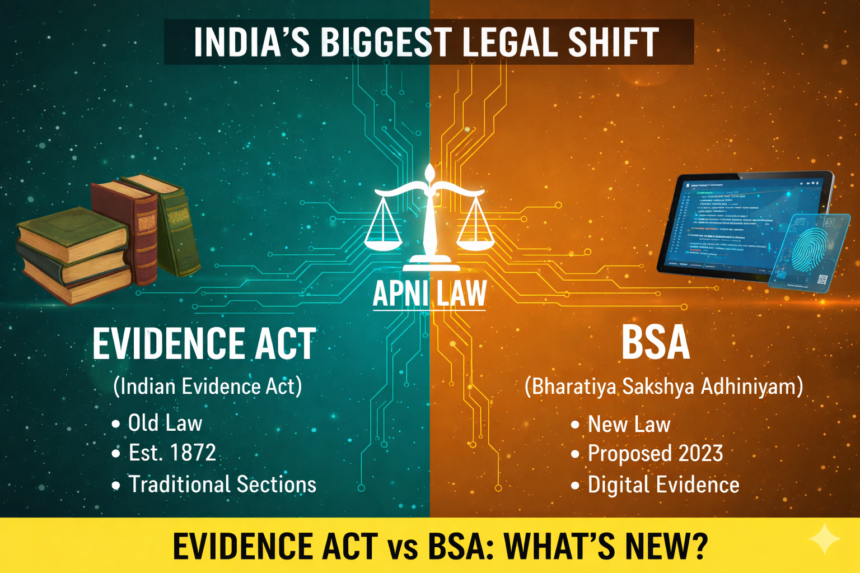
Section 39 of the Bharatiya Sakshya Adhiniyam, 2023 replaces Section 45 of the Indian Evidence Act. The new law came into force on 1 July 2024. Parliament introduced it to modernise evidence law and align it with technological developments. Courts today regularly deal with cybercrime, electronic records, and digital forensics. The old provision did not adequately address these realities.
Section 39 preserves the core principle of expert evidence but expands its scope. It recognises that expertise now extends far beyond traditional fields like handwriting or fingerprints. By doing so, it ensures that courts can rely on modern scientific and technical knowledge without legal uncertainty.
How Is the Scope of Expert Evidence Expanded Under Section 39 BSA?
Section 39(1) of the BSA closely follows the language of Section 45 IEA but introduces a crucial expansion. It allows expert opinions not only in science, art, and foreign law but also in “any other field.” This phrase significantly widens judicial access to expert knowledge.
Courts can now admit opinions from experts in emerging areas such as data science, artificial intelligence, environmental science, blockchain technology, and forensic accounting. The provision removes the need for courts to stretch traditional categories to fit modern disputes. It gives judges flexibility while maintaining evidentiary discipline.
What Is the Role of Electronic Evidence Experts Under Section 39(2) BSA?
Section 39(2) introduces a completely new legal recognition. It specifically addresses electronic and digital evidence. When a case involves information stored or transmitted through a computer resource or digital form, the opinion of the Examiner of Electronic Evidence becomes relevant.
This examiner is defined under Section 79A of the Information Technology Act, 2000. The law therefore creates a direct statutory link between evidence law and cyber law. This change strengthens the evidentiary value of digital forensics reports. It also promotes consistency and reliability in cases involving electronic records.
How Does Section 45 IEA Compare Structurally With Section 39 BSA?
Section 45 of the Indian Evidence Act exists as a single, consolidated provision. It does not distinguish between traditional and digital experts. As a result, courts earlier relied on judicial interpretation to admit electronic expert evidence.
Section 39 of the BSA adopts a clearer structure. Subsection (1) deals with general expert opinions. Subsection (2) exclusively governs electronic evidence experts. This separation removes ambiguity and reflects legislative awareness of modern evidentiary needs. The structure itself signals the growing importance of digital evidence in criminal and civil litigation.
Does the BSA Change the Legal Value of Expert Opinion?
The Bharatiya Sakshya Adhiniyam does not elevate expert opinion to binding proof. Courts continue to treat expert evidence as advisory. Judges must still examine the reasoning, methodology, and consistency of the opinion. They must also consider corroborative evidence.
Provisions corresponding to Section 46 of the Indian Evidence Act, now Section 40 of the BSA, remain applicable. These provisions allow courts to examine the grounds of expert opinions and test their reliability. The basic philosophy of cautious reliance remains unchanged.
How Does Section 39 BSA Improve Adjudication in Cyber and Technology Cases?
The explicit recognition of electronic evidence experts strengthens prosecutions and defences in cybercrime cases. Courts no longer need to rely on general scientific experts for highly technical digital issues. Certified electronic examiners now have clear statutory backing.
This change improves evidentiary clarity in cases involving hacking, data theft, online fraud, digital surveillance, and electronic contracts. It also enhances judicial confidence while evaluating complex technological evidence. As a result, adjudication becomes faster, more accurate, and legally robust.
Conclusion
Section 39 of the Bharatiya Sakshya Adhiniyam represents a clear evolution of Section 45 of the Indian Evidence Act. It preserves foundational principles while embracing modern realities. The law now speaks the language of digital evidence and technological expertise.
By expanding the scope of expert evidence and formally recognising electronic examiners, the BSA ensures that Indian evidence law remains relevant, adaptable, and future-ready.