Introduction
An admission is one of the most important concepts in evidence law because it directly affects how facts are proved in court. Under Indian law, an admission refers to a statement that suggests an inference about a fact in issue or a relevant fact. Such a statement may be oral, documentary, or in electronic form. Admissions are significant because they come from the parties themselves or from persons connected with them, making them highly persuasive in judicial proceedings. Both the Indian Evidence Act, 1872, and its successor, the Bharatiya Sakshya Adhiniyam, 2023, treat admissions as a key tool for determining truth in litigation.
How Does Section 17 of the Indian Evidence Act Define Admission?
Section 17 of the Indian Evidence Act, 1872, provides the foundational definition of admission. It states that an admission is a statement, oral or documentary or contained in electronic form, which suggests any inference as to a fact in issue or a relevant fact. The provision further clarifies that such a statement must be made by specific persons and under particular circumstances laid down in subsequent sections. This definition is broad and flexible, allowing courts to consider a wide range of statements as admissions, provided they help in drawing an inference related to the dispute before the court.
What Is the Definition of Admission Under Section 15 of the Bharatiya Sakshya Adhiniyam?
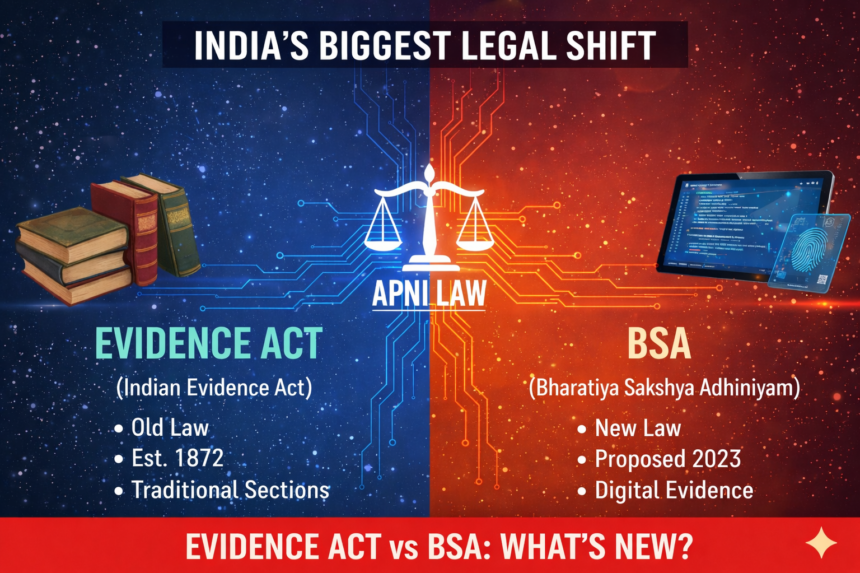
Section 15 of the Bharatiya Sakshya Adhiniyam, 2023, reproduces the definition of admission almost word for word from Section 17 of the Indian Evidence Act. It describes an admission as a statement, oral, documentary, or electronic, that suggests an inference regarding a fact in issue or a relevant fact. The continuity in language shows that the legislature intended to retain the established legal understanding of admissions while transitioning to the new evidence law framework. The Bharatiya Sakshya Adhiniyam officially replaced the Indian Evidence Act from 1 July 2024, but the core principles governing admissions remain unchanged.
Is There Any Difference Between Section 17 IEA and Section 15 BSA?
There is no substantive difference between Section 17 of the Indian Evidence Act and Section 15 of the Bharatiya Sakshya Adhiniyam. The wording, scope, and legal effect of both provisions are identical. Section 15 BSA is a direct counterpart of Section 17 IEA. This legislative continuity ensures that judicial precedents developed over more than a century under the Evidence Act will continue to guide courts under the new law. Lawyers and judges can therefore rely on existing interpretations without uncertainty or disruption.
Why Are Electronic Admissions Recognised Under Both Laws?
Both Section 17 IEA and Section 15 BSA explicitly recognise statements contained in electronic form as admissions. This inclusion reflects the impact of the Information Technology Act, 2000, which modernised Indian evidence law by acknowledging electronic records. Emails, text messages, digital documents, and other electronic communications can now constitute valid admissions if they satisfy the legal requirements. This recognition ensures that evidence law keeps pace with technological developments and modern modes of communication.
Who Can Make an Admission Under Evidence Law?
While Sections 17 IEA and 15 BSA define admission, the subsequent sections explain who can make such statements. Admissions may be made by parties to the proceeding, their authorised agents, persons from whom the parties derive interest, or individuals whose position or liability is in issue. Both laws follow the same structure, with the Bharatiya Sakshya Adhiniyam closely mirroring the corresponding provisions of the Indian Evidence Act. This structural similarity preserves clarity and consistency in determining the admissibility of admissions.
What Is the Evidentiary Value of Admissions?
Admissions carry high evidentiary value because they originate from the party against whom they are used. Courts treat admissions as substantive evidence, meaning they can be relied upon to prove facts without the need for further corroboration. However, admissions are not conclusive proof. They may be explained or rebutted by the maker. In certain circumstances, admissions can also operate as estoppel, preventing the maker from denying the truth of the admitted fact. Their probative strength depends on the context, clarity, and voluntariness of the statement.
Are Admissions Always Admissible in Court?
Admissions are generally admissible when they are self-harming, meaning they go against the interest of the person making them. Self-serving statements, on the other hand, are usually not admissible because they lack reliability. Courts have consistently followed this principle under both the Indian Evidence Act and the Bharatiya Sakshya Adhiniyam. There are limited exceptions where self-serving statements may be relevant, such as when they form part of a dying declaration or explain relevant conduct. These principles remain unchanged under the new law.
How Do Courts Treat Admissions Under the Bharatiya Sakshya Adhiniyam?
Courts interpret admissions under the Bharatiya Sakshya Adhiniyam in the same manner as under the Indian Evidence Act. Since Section 15 BSA is identical to Section 17 IEA, earlier judicial decisions continue to apply. Admissions are assessed carefully, with courts examining whether the statement was voluntary, clear, and relevant to the facts in issue. When properly proved, admissions can decisively influence the outcome of a case.
Conclusion
The seamless transition from Section 17 IEA to Section 15 BSA ensures legal certainty and stability. Evidence law plays a crucial role in the justice system, and abrupt changes could create confusion. By retaining the same definition and framework for admissions, the Bharatiya Sakshya Adhiniyam preserves well-settled legal principles while updating the statute for modern India. This continuity reinforces confidence in the evidentiary process and upholds the reliability of admissions as a powerful form of proof in court.