Introduction
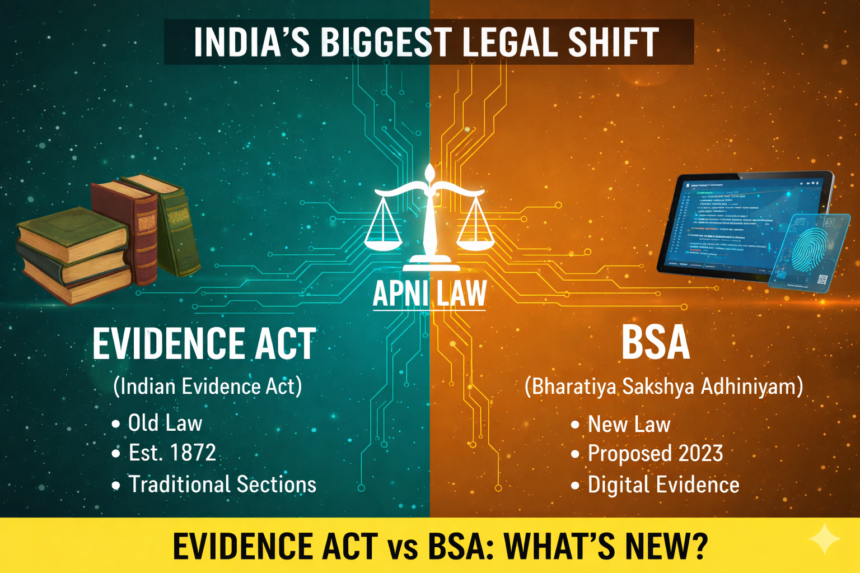
The comparison between Section 65 of the Indian Evidence Act, 1872 and Section 61 of the Bharatiya Sakshya Adhiniyam, 2023 highlights the shift in Indian evidence law from a paper-centric system to a digitally inclusive framework. While Section 65 of the Evidence Act deals with when secondary evidence may replace primary evidence, Section 61 of the BSA focuses on ensuring that electronic and digital records are not rejected merely because of their form. Both provisions address documentary evidence, but their intent, scope, and legal philosophy differ significantly.
What Does Section 65 of the Indian Evidence Act Provide?
Section 65 of the Indian Evidence Act lays down the exceptions to the primary evidence rule. The law prefers original documents because they are the best proof of contents. However, Section 65 recognizes that originals are not always available. It therefore permits secondary evidence in specific and limited circumstances.
Secondary evidence becomes admissible when the original document is lost, destroyed, or cannot be produced despite reasonable efforts. It is also allowed when the original is in the possession of the opposing party who fails to produce it after receiving legal notice. Public documents may be proved by certified copies without producing originals. The section also applies where the original is immovable, bulky, or located beyond the jurisdiction of the court.
Section 65 functions as a gatekeeping provision. It balances fairness and practicality by allowing justice to proceed even when originals are unavailable, while still protecting against misuse of inferior evidence.
How Does Section 65 Treat Electronic Records?
Under the original framework of the Evidence Act, electronic records were not treated as primary evidence. They were generally considered secondary unless accompanied by compliance with Section 65B. This approach created procedural hurdles and frequent litigation over admissibility. Courts often rejected electronic evidence for technical non-compliance, even when authenticity was not disputed.
Section 65 therefore represents a traditional evidence model where physical originals are central and copies are exceptions.
What Is the Objective of Section 61 of the Bharatiya Sakshya Adhiniyam?
Section 61 of the Bharatiya Sakshya Adhiniyam marks a paradigm shift in evidence law. It clearly states that no electronic or digital record shall be denied admissibility merely because it is electronic in nature. The provision ensures that digital records are placed on an equal footing with traditional documents.
This section removes the historical bias against electronic evidence. It recognizes the realities of modern communication, commerce, and governance, where documents are often created, stored, and transmitted only in digital form.
How Does Section 61 of the BSA Change the Treatment of Digital Evidence?
Section 61 ensures that electronic records are not automatically treated as secondary evidence. Where electronic records are produced from proper custody and meet statutory conditions, they can qualify as primary evidence. Copies of electronic records are also admissible, subject to proof requirements under Section 63 of the BSA.
This approach eliminates the artificial hierarchy that previously placed electronic records at a disadvantage. It reflects legislative intent to simplify trials and reduce unnecessary technical objections.
How Does Section 61 of the BSA Differ from Section 65 of the Evidence Act?
The core difference lies in focus and philosophy. Section 65 of the Evidence Act addresses when secondary evidence is allowed instead of the original. Section 61 of the BSA addresses whether electronic evidence can be rejected due to its format.
Section 65 is conditional and exception-based. Section 61 is inclusive and enabling. Section 65 presumes physical originals as the norm. Section 61 accepts digital records as a legitimate norm of evidence.
While Section 65 operates after the primary-secondary distinction is triggered, Section 61 operates at the threshold of admissibility.
How Does the BSA Redefine Primary and Secondary Evidence?
The Bharatiya Sakshya Adhiniyam introduces a modern definition of primary evidence. Section 57 of the BSA expands the concept of primary evidence through multiple explanations. It clarifies that when data is stored in multiple electronic files, each file can be treated as primary evidence.
Section 62 of the BSA continues to define primary evidence as the document itself produced for inspection. However, the definition now comfortably accommodates electronic records without forcing them into the secondary evidence category.
What Is the Role of Section 63 of the BSA in This Framework?
Section 63 of the BSA governs the proof of electronic records, similar to Section 65B of the Evidence Act. It lays down certification and authenticity requirements. However, Section 61 clarifies that Section 63 is an enabling provision, not a restrictive one.
This means electronic evidence is not excluded at the outset. The focus shifts from rigid admissibility barriers to assessing reliability and authenticity
Conclusion
Section 65 of the Evidence Act and Section 61 of the BSA do not perform the same function. Section 65 deals with exceptions to the primary evidence rule. Section 61 ensures non-discrimination against electronic evidence. One is restrictive by design. The other is facilitative by intent.
Understanding this distinction is essential for effective litigation under the Bharatiya Sakshya Adhiniyam. The future of evidence law in India is digital, and Section 61 ensures the law evolves with that reality.