Introduction
Section 11 of the Indian Evidence Act, 1872 and Section 10 of the Bharatiya Sakshya Adhiniyam, 2023 serve the same legal purpose. Both provisions expand the concept of relevancy in evidence law. They allow courts to admit facts that are otherwise irrelevant when those facts either contradict facts in issue or make their existence or non-existence highly probable or improbable. These sections ensure that courts do not ignore surrounding circumstances that logically or physically affect the truth of a case.
How Do These Sections Define “Facts Inconsistent with Facts in Issue”?
Both Section 11 IEA and Section 10 BSA treat inconsistency as a ground of relevancy. A fact becomes relevant when it directly contradicts a fact in issue or a relevant fact. For example, if the prosecution claims that the accused committed a murder at a specific place and time, evidence showing that the accused was present at a distant location at the same time becomes relevant. The inconsistency itself makes the evidence admissible.
How Do These Provisions Address Probability and Improbability?
The second limb of both sections focuses on probability. A fact becomes relevant if, by itself or when combined with other facts, it makes the existence or non-existence of a fact in issue highly probable or highly improbable. The law does not require the fact to be independently relevant. Its value lies in its logical effect on the main issue. This allows courts to consider contextual facts that strengthen or weaken the likelihood of the prosecution or defence story.
Are the Texts of Section 11 IEA and Section 10 BSA Different?
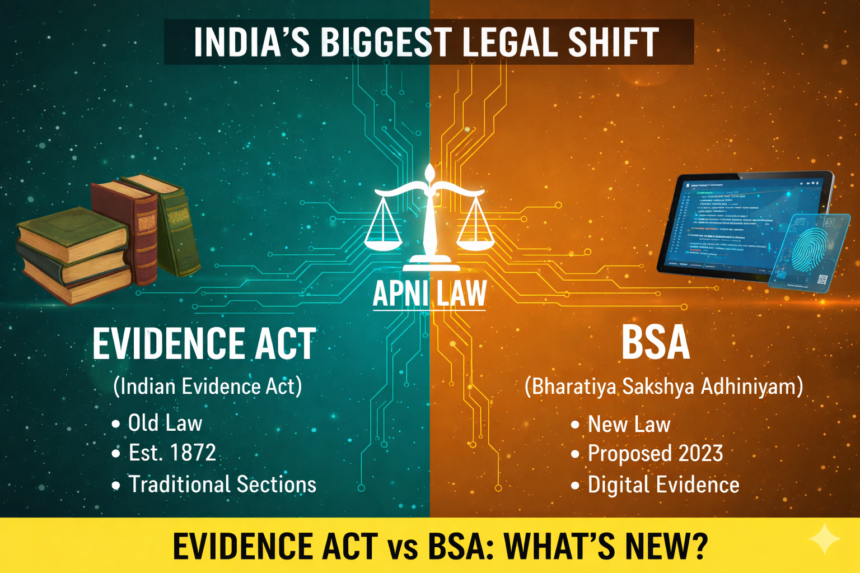
There is no textual difference between the two provisions. Section 10 of the Bharatiya Sakshya Adhiniyam reproduces Section 11 of the Indian Evidence Act verbatim. Both clauses are identical. The illustrations provided under both sections are also the same. This shows clear legislative intent to continue the settled principles of relevancy without modification under the new evidence law.
What Do the Illustrations under These Sections Explain?
The illustrations clarify how the sections operate in practice. One illustration explains the plea of alibi, where the accused proves presence at another place during the commission of the offence. Another illustration shows how evidence of a person being alive becomes relevant when the issue is whether that person is dead. These examples demonstrate how inconsistency and improbability make otherwise irrelevant facts admissible.
Why Are These Provisions Important for the Plea of Alibi?
The plea of alibi is the most common application of Section 11 IEA and Section 10 BSA. When an accused claims that they were elsewhere at the time of the offence, that fact directly contradicts the prosecution case. Courts admit such evidence under these provisions because it creates a physical impossibility of the accused committing the crime. However, courts require strict proof of alibi because it directly challenges the prosecution’s version.
How Do Courts Apply the Test of Physical or Logical Impossibility?
Courts apply a strict judicial test while admitting evidence under these sections. The inconsistency must be real and convincing. Mere doubt is not enough. The defence must show that the prosecution version becomes physically or logically impossible. For example, if an accused claims to be in Kerala while the crime occurred in Delhi at the same time, the court examines travel feasibility, timing, and corroboration before accepting the claim.
Does the Burden of Proof Shift under These Sections?
The prosecution always bears the primary burden of proving guilt beyond reasonable doubt. However, when the accused raises a plea under Section 11 IEA or Section 10 BSA, the burden shifts to the accused to establish the inconsistent or improbable fact. Courts have consistently held that alibi evidence must be proved with certainty and supported by reliable material.
What Is the Judicial Approach in Criminal Trials?
Indian courts have repeatedly emphasized caution while applying these sections. In cases like Binay Kumar Singh v. State of Bihar, the Supreme Court held that alibi evidence must be tested with great care. Courts usually assess the prosecution evidence first. Only after the prosecution establishes a prima facie case does the court examine whether the defence evidence creates a genuine inconsistency or improbability.
Has the Bharatiya Sakshya Adhiniyam Changed the Legal Position?
The Bharatiya Sakshya Adhiniyam has not altered the scope or application of this principle. Section 10 BSA continues the same rule that existed under Section 11 IEA. Criminal trials, civil proceedings, and evidentiary standards remain unaffected. Courts will continue to rely on earlier judicial interpretations while applying the new provision.
Conclusion
These provisions prevent mechanical application of relevancy rules. They allow courts to consider real-world probabilities and impossibilities. By admitting facts that expose inconsistencies or improbabilities, the law ensures fairness to the accused and accuracy in judicial findings. Section 11 IEA and Section 10 BSA together reinforce logical reasoning as the foundation of evidence law in India.