


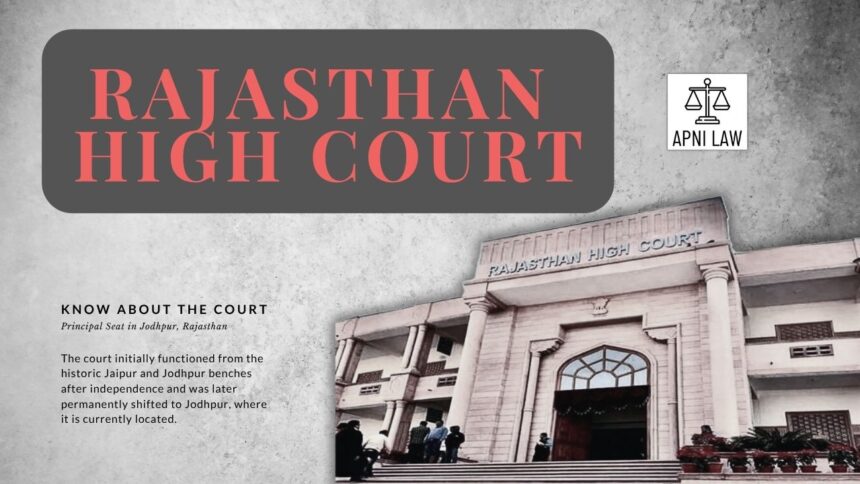
Single-judge bench reiterates maintenance under Section 125 CrPC must balance needs, earning potential and circumstances, rejects income-sharing formula.
The Rajasthan High Court, in Ritu Khatri v. Navneet Khanna, dismissed a wife’s petition seeking enhancement of maintenance beyond ₹8,000 per month, ruling that a husband’s high income alone does not entitle a spouse to a proportionate share of earnings. The order was delivered by Justice Farjand Ali on 3 February 2026.
Case Background
The petitioner-wife and respondent-husband were married in 2024, but the matrimonial relationship lasted only 57 days. After separation, the woman filed for maintenance under Section 125 of the Code of Criminal Procedure (CrPC), alleging her inability to support herself. The Family Court at Sri Ganganagar granted maintenance at ₹8,000 per month.
Dissatisfied with this sum, the petitioner challenged the quantum before the Rajasthan High Court, highlighting that her husband was a government employee earning over ₹1.5 lakh per month and owned property, and that the maintenance awarded was inadequate and disproportionate.
Legal Issue
The central legal issue was whether maintenance awards under Section 125 CrPC can be automatically increased to reflect a husband’s high income, or whether courts must consider a balanced assessment of the spouse’s needs, earning potential and other relevant circumstances.
Court’s Reasoning
Income Alone Not Determinative: The High Court observed that maintenance is not a fixed proportion of the husband’s income. It held that awarding a maintenance amount solely because the husband earns more would, in effect, convert maintenance proceedings into a de facto income-sharing or property division claim, which is impermissible under the law.
Earning Potential and Qualifications: The court took into account the petitioner’s academic and professional qualifications. It noted that while she is currently unemployed, this alone did not conclusively prove her inability to maintain herself. The Court emphasised that earning potential and past employment experience are relevant in assessing the appropriate quantum of maintenance.
Duration of Marriage: The brief duration of the marriage, only 57 days, was also treated as a relevant factor. Although not determinative, the short span was seen as relevant for evaluating the “nature of dependency” and the extent to which a common standard of living was established between the parties.
Conduct of Parties: The Bench noted the respondent’s regular compliance with the Family Court’s maintenance order, taking this into account as indicative of his bona fide conduct. The court stressed that conduct and equity play a role in judicial decision-making.
Drawing on these aspects, the Court found no illegality or perverse exercise of discretion in the Family Court’s maintenance order. Consequently, it declined to enhance the maintenance amount. The revision petition was dismissed.
Final Ruling
- The High Court upheld the Family Court’s order awarding maintenance at ₹8,000 per month.
- The petition for enhancement was dismissed.
Practical Implications
Clarifying Maintenance Principles: This judgment reinforces the principle that maintenance under Section 125 CrPC is intended to prevent destitution, not to act as income sharing or a property division mechanism.
Balanced Assessment Required: Courts must look beyond a spouse’s current unemployment and consider earning potential, qualifications, duration of marriage, and conduct while fixing the quantum of maintenance, rather than relying on the other party’s high salary alone.
Judicial Discretion Upheld: The ruling affirms that a family court’s determination of maintenance, when based on relevant factors and reasonable assessment, should not be interfered with as long as there is no manifest illegality or perversity.
The judgment adds clarity on the approach to maintenance awards, emphasising that high income of a spouse does not automatically translate to a proportionate maintenance obligation, and that courts must exercise discretion based on a holistic assessment of circumstances in matrimonial maintenance disputes.




