


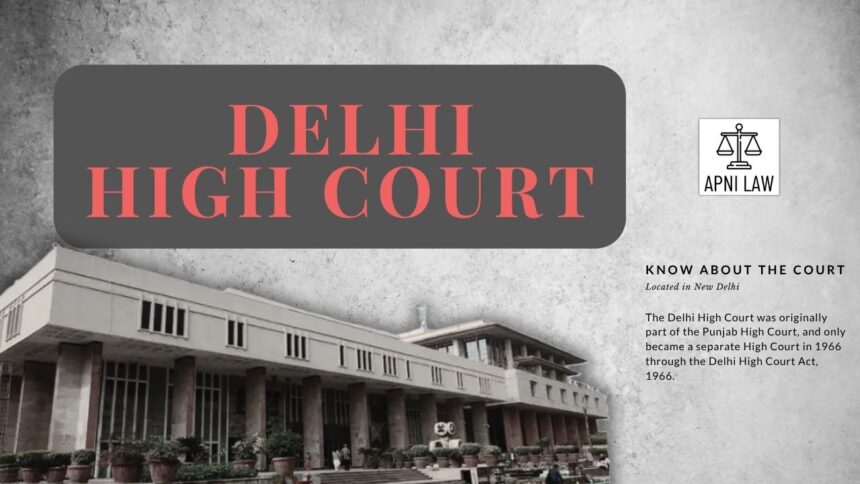
New Delhi, January 29, 2026: The Delhi High Court on Thursday dismissed a defamation suit filed by Indian Revenue Service (IRS) officer Sameer Dnyandev Wankhede against Netflix and others over his alleged portrayal in the web series. The Bench of Justice Purushaindra Kumar Kaurav held that the High Court lacks territorial jurisdiction to entertain the suit and returned the plaint, allowing Wankhede to approach a court of competent jurisdiction.
Case Title & Parties
Sameer Dnyandev Wankhede v. Red Chillies Entertainments Pvt. Ltd. & Ors.
Defendants:
- Red Chillies Entertainment Pvt. Ltd.
- Netflix
- X Corp (formerly Twitter)
- Google LLC
- Meta Platforms
- RPG Lifestyle Media Pvt. Ltd.
- John Doe (unnamed defendant)
Background
Wankhede, a former Narcotics Control Bureau (NCB) officer who rose to prominence following the 2021 cruise ship drug raid involving actor Aryan Khan, claimed that the Netflix series The Ba**ds of Bollywood included scenes that he alleged were defamatory to his reputation. The show is directed by Aryan Khan and produced by Shah Rukh Khan’s Red Chillies Entertainment.
In his plaint, Wankhede argued that the series depicted a character who resembled him and portrayed a sensitive gesture, a character showing a middle finger immediately after reciting “Satyamev Jayate”, which he claimed amounted to defamation and contravention of the Prevention of Insults to National Honour Act, 1971. He sought ₹2 crore in damages, proposing that any award be donated to the Tata Memorial Cancer Hospital for cancer treatment. Wankhede also sought permanent and mandatory injunctions to restrain further dissemination of the alleged defamatory content.
Legal Issue
The principal legal question before the High Court was whether the Delhi High Court could entertain a defamation suit over online content that is globally accessible, where neither the plaintiff nor the main defendants were domiciled in Delhi, and whether such a suit was maintainable in the national capital based on alleged reputational harm felt in that jurisdiction.
Court’s Ruling
Justice Kaurav ruled that the Delhi High Court lacks territorial jurisdiction to hear the defamation suit. The Court did not proceed to examine the merits of the defamation claims but focused on territorial jurisdiction principles in cases of online defamation. It returned the plaint to Wankhede to be filed in a court of competent jurisdiction.
“This Court lacks the jurisdiction to entertain the plaint. The same is, therefore, returned to the plaintiff to be presented, if so advised, before a court of competent jurisdiction,” the order stated.
Court’s Reasoning
The High Court reiterated established principles on territorial jurisdiction in online defamation cases. It held that the mere accessibility of content over the internet across jurisdictions does not confer universal jurisdiction on any court chosen by the plaintiff. Citing precedents, including Escorts Ltd. v. Tejpal Singh Sisodia, the Bench emphasised that a suit must be filed either:
- where the defendant resides or carries on business, or
- where the substantial portion of the wrong (reputational harm) has occurred.
Wankhede, a resident of Mumbai and presently posted in Chennai, contended that reputational harm was felt in Delhi due to accessibility of the content among senior officials and media. The Court found that this did not suffice to confer jurisdiction. It observed that the wrong of defamation cannot be assumed to occur in a place where the plaintiff has not established concrete reputational damage.
The Court also noted that Red Chillies and Netflix’s principal places of business are in Mumbai, and thus the suit should be filed in forums with appropriate territorial connection.
Practical Implications
- The judgment clarifies that online defamation suits cannot be filed in any forum where content is accessible; plaintiffs must establish territorial linkages either with the defendant’s location or where tangible reputational harm has occurred.
- It reinforces the principles articulated in Escorts Ltd. v. Tejpal Singh Sisodia pertaining to jurisdiction in internet-based defamation.
- Content creators and OTT platforms can reference this framework when defending against defamation claims arising from widely accessible digital content.
- Plaintiffs alleging online defamation must now more rigorously establish jurisdictional foundations before filing suits.
The judgment adds clarity on territorial jurisdiction in online defamation cases, particularly how and where such lawsuits may be instituted when content is globally accessible but the plaintiff and defendants are not domiciled in the chosen forum.




