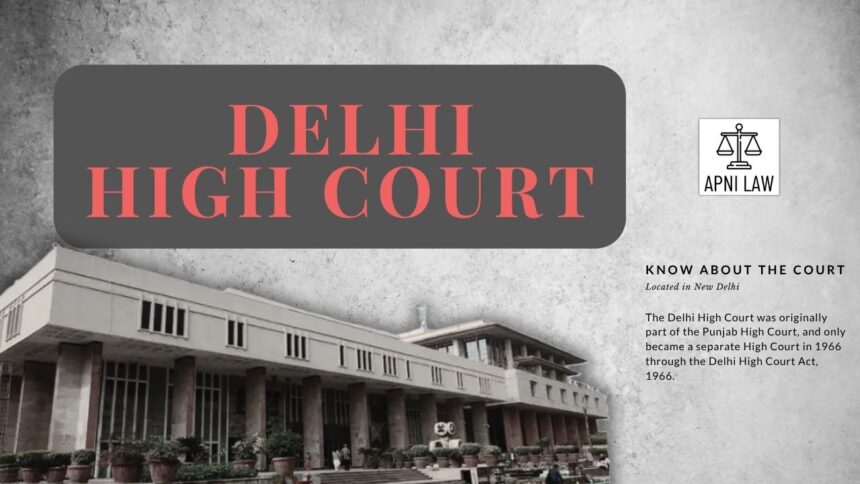
Division Bench holds marriage contracted during subsistence of first marriage void under Hindu Marriage Act, rejects pension claim under Army Pension Regulations, 1961.
The Delhi High Court has ruled that a woman whose marriage to an Army serviceman was solemnised during the lifetime of his first wife cannot claim family pension under the Army Pension Regulations, 1961, even if the first wife has since passed away.
A Division Bench comprising Justice V. Kameswar Rao and Justice Manmeet Pritam Singh Arora delivered the judgment on 26 February 2026 in a petition challenging the denial of family pension to the second wife on the ground that her marriage was void in law.
Case Background
The petitioner, entered into a second marriage with Army sepoy Udey Singh while his first wife, was still alive and legally married to him. Udey Singh died in September 2011. The first wife received family pension following his death and continued to be recognised as the lawful spouse. After the first wife’s death in May 2012, the petitioner sought to be included as a nominee for family pension, asserting that the marriage had endured and that the first wife’s demise should validate her status.
The Armed Forces Tribunal and pension authorities rejected the claim on the basis that the union was void ab initio. The petitioner filed a writ petition before the Delhi High Court challenging that rejection.
Legal Issue
The principal legal issue before the High Court was whether a marriage solemnised during the subsistence of a previously existing marriage, void under the Hindu Marriage Act, 1955, could later become valid for pension benefits upon the death of the first spouse, for the limited purpose of family pension under Army Regulations.
Court’s Reasoning
The Bench analysed Sections 5 and 11 of the Hindu Marriage Act, 1955, which deem a second marriage contracted during the lifetime of the first spouse, without legal dissolution, to be void in law. The court underscored that monogamy is a central tenet of Hindu marriage law and that a second marriage during the subsistence of the first cannot confer legal spousal status at any subsequent point.
The court rejected the petitioner’s argument that the death of the first wife could validate the second union for pensionary purposes. It noted that the Army Pension Regulations, 1961 envisage family pension only for a “lawfully married” spouse. A marriage void from the outset could not retrospectively be elevated to “lawful” status by the happening of a later event, such as the death of a spouse.
The Bench also addressed reliance placed on precedents where pensionary rights were extended despite documentary gaps; it clarified that such authorities did not concern marriages void under the Hindu Marriage Act, and therefore held limited relevance.
In its verdict, the High Court upheld the view that the petition was correctly dismissed by the authorities and that the denial of family pension did not warrant interference.
Final Ruling
The Delhi High Court dismissed the writ petition and upheld the original decision denying family pension benefits to the second wife. The Bench affirmed that:
- A second marriage solemnised during the subsistence of the first marriage is treated as void ab initio under the Hindu Marriage Act, 1955.
- Such void marriages do not become valid by the subsequent death of the first spouse.
- Only a legally wedded wife under the applicable law is entitled to family pension under the Army Pension Regulations, 1961.
Practical Implications
- This ruling reinforces the principle that marriages entered into during the existence of a prior marriage cannot acquire validity retrospectively for the purpose of pensionary benefits, even if the first spouse dies.
- Pension authorities and tribunals must continue to apply monogamy requirements under the Hindu Marriage Act when determining eligibility for family pension.
- The judgment aligns with other recent High Court decisions, including from the Madras High Court and Orissa High Court, which have similarly held that void second marriages do not confer pension rights simply due to the first spouse’s subsequent death.
The judgment adds clarity on the legal position that marriages void under the Hindu Marriage Act cannot generate rights to family pension under Army Pension Regulations merely due to subsequent events such as the death of a prior spouse.