

Introduction
The Court acquitted four accused convicted under Sections 306/34 IPC, holding that the prosecution failed to establish the intention to instigate or drive the deceased to commit suicide.
Background
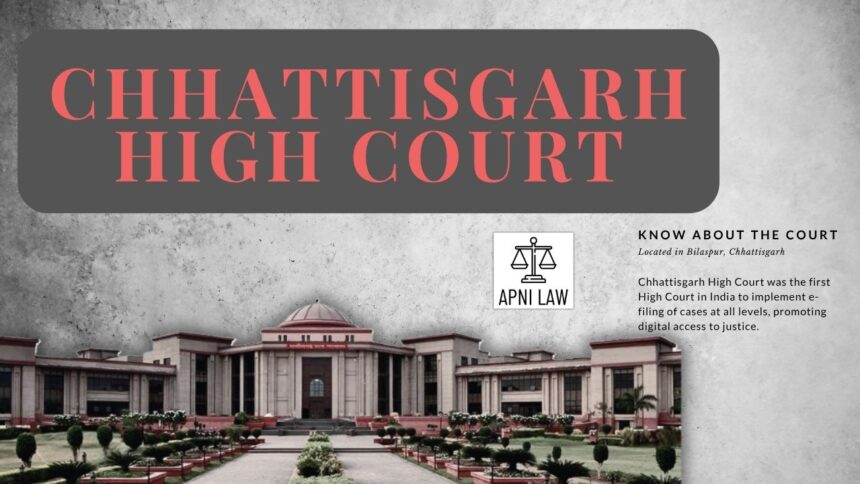
The Chhattisgarh High Court acquitted four accused who had been convicted of abetment of suicide under Sections 306 read with 34 of the Indian Penal Code (IPC). Justice Naresh Kumar Chandravanshi held that an assault occurring five days before a woman’s suicide does not, by itself, establish abetment of suicide without evidence of the accused’s intention to instigate her to take her life.
The accused had appealed against their conviction by the Second Upper Sessions Judge, who had sentenced them to 10 years of rigorous imprisonment.
According to the prosecution, the deceased was at the house of her prospective husband when the accused, who were her distant relatives, objected to their presence together. A quarrel followed, during which the accused allegedly assaulted the couple. The prosecution claimed that the incident distressed the woman and that she consumed poison and died approximately five days later.
The accused challenged the conviction, arguing that the incident arose from a dispute over the couple’s presence in the house. They contended that there was no intention to instigate the deceased to commit suicide. They also questioned the reliance on an alleged suicide note, arguing that the handwriting expert’s report had not been proved.
Legal Issue
The main issue before the High Court was whether the assault and the subsequent suicide were sufficient to establish the offence of abetment of suicide under Section 306 IPC.
Section 306 IPC provides for punishment when a person abets the commission of suicide. To establish this offence, the prosecution must prove the necessary ingredients of abetment under Section 107 IPC, including instigation, conspiracy, or intentional aid, as applicable to the facts of the case.
The Court considered whether the prosecution had established a connection between the accused’s conduct and the woman’s decision to end her life. It also examined whether there was evidence of the required mens rea, or guilty intention, to instigate or drive her to commit suicide.
Court Ruling
The High Court acknowledged that the prosecution had established that the accused assaulted the deceased and her prospective husband. However, it found that the evidence did not establish that the assault was committed with the intention of instigating the woman to commit suicide.
The Court also considered the interval between the assault and the woman’s death. The deceased died approximately five days after the incident. The Court observed that the prosecution had failed to establish the necessary link between the incident and the alleged abetment of suicide.
The Court remarked that if the deceased had felt insulted to such an extent that she was compelled to commit suicide, she might have done so immediately after the incident. However, she died by suicide approximately five days later.
The Court emphasised that a conviction under Section 306 IPC requires clear, conscious and deliberate intention on the part of the accused to instigate or drive the victim to commit suicide. The occurrence of a quarrel or assault before a suicide does not automatically establish this intention.
The Court further observed that a person cannot be held criminally responsible merely because another person ends their life due to depression, frustration or hypersensitivity over a trivial issue. The prosecution must establish that the accused actively instigated, goaded or otherwise abetted the suicide in accordance with the legal requirements.
Finding that the essential ingredients of abetment of suicide had not been proved, the High Court set aside the conviction and sentence imposed under Sections 306/34 IPC and acquitted all four accused.
Implications
The judgment highlights the distinction between conduct that may cause distress and conduct that legally amounts to abetment of suicide. Even where an assault or quarrel is established, the prosecution must prove the necessary ingredients of abetment and the accused’s culpable intention, where required by the applicable form of abetment.
The decision also underscores that the timing of an incident in relation to a suicide may be relevant when assessing the evidence, but the passage of five days does not, by itself, determine whether abetment occurred. The question remains whether the prosecution has established the required legal connection and ingredients through the evidence on record.
The ruling reinforces that criminal liability under Section 306 IPC cannot rest solely on the fact that a person died by suicide after a dispute or assault. The prosecution must prove the offence beyond reasonable doubt.
The judgment adds clarity on the evidentiary requirements for establishing abetment of suicide and the need to prove the essential ingredients of Section 306 IPC before a conviction can be sustained.
Case Title: Smt. Lakhapatiya Bai & Ors. v. State of Chhattisgarh