Introduction
Section 91 of the Indian Evidence Act, 1872, and Section 94 of the Bharatiya Sakshya Adhiniyam, 2023, embody the well-known “best evidence rule.” This rule gives primacy to documentary evidence over oral statements. When parties reduce the terms of a contract, grant, or property disposition to writing, the law requires courts to look only at the document to ascertain those terms. Oral evidence cannot replace, add to, or vary what the document records. The rule protects certainty in legal transactions and prevents disputes based on unreliable recollections.
Why Did the Law Replace Section 91 IEA With Section 94 BSA?
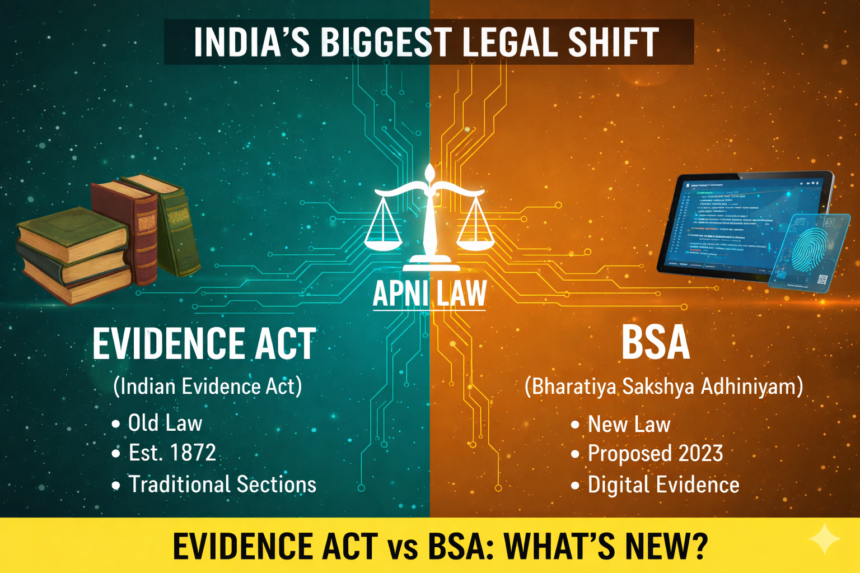
The Bharatiya Sakshya Adhiniyam, 2023, repealed the Indian Evidence Act with effect from 1 July 2024. Section 94 of the BSA corresponds directly to Section 91 of the IEA. The legislature did not intend to change the substance of the law. It merely reorganised and renumbered provisions. The wording of Section 94 BSA mirrors Section 91 IEA almost verbatim. Courts therefore continue to apply earlier judicial interpretations without disruption.
What Does Section 91 IEA Actually Provide?
Section 91 states that when the terms of a contract, grant, or other disposition of property are reduced to writing, the document itself must prove those terms. The same rule applies where the law requires a transaction to be in writing. Parties may produce the original document as primary evidence or secondary evidence when permitted by law. They cannot rely on oral testimony to prove the contents of the document. This exclusion operates regardless of whether the oral evidence comes from a party to the document or a third person.
How Does Section 94 BSA Reproduce the Same Principle?
Section 94 of the Bharatiya Sakshya Adhiniyam restates the same rule in modern legislative language. It affirms that documentary evidence prevails whenever written form governs a transaction. The proviso structure and explanations remain the same. The section continues to exclude oral evidence that seeks to establish the terms of a written instrument. No new exception or relaxation appears in the BSA. The continuity ensures stability in contract and property litigation.
What Is the Purpose Behind Excluding Oral Evidence?
The law excludes oral evidence to preserve the sanctity of written instruments. Written documents provide clarity, permanence, and reliability. Oral statements are vulnerable to error, exaggeration, or manipulation. If courts allowed parties to contradict documents through oral claims, written contracts would lose their value. Section 91 and Section 94 prevent such uncertainty. They promote commercial confidence and reduce unnecessary litigation.
How Do the Explanations Clarify the Rule?
Both provisions contain explanations that expand their scope. When several documents form part of one transaction, the rule applies to all of them collectively. If a contract exists in multiple originals, producing one original suffices. The explanations also clarify that oral evidence may prove facts stated in the document but not the terms themselves. These clarifications ensure that courts apply the rule practically without undermining its core purpose.
How Does the Rule Apply to Contracts?
In contract law, Section 91 IEA and Section 94 BSA operate as a merger rule. Once parties reduce their agreement to writing, prior or contemporaneous oral negotiations merge into the document. Parties cannot rely on oral promises inconsistent with the written terms. The court looks only at the contract as executed. Exceptions arise only through other provisions, such as fraud, mistake, or illegality, which are addressed separately under the law.
How Does the Rule Affect Property Transactions and Wills?
Property transactions often require written instruments by statute. Registered sale deeds, gift deeds, and leases fall squarely within this rule. Parties cannot prove ownership terms or conditions through oral evidence when the law mandates documentation. The same logic applies to wills. Courts determine testamentary intent from the written will itself. Oral assertions about what the testator intended carry no evidentiary value unless permitted under specific legal exceptions.
How Do Courts Use Section 91 and Section 94 Together With Other Provisions?
Section 91 IEA historically worked alongside Section 92, which barred oral evidence contradicting admitted documents. Under the BSA, Section 95 performs the same complementary role. Section 91 or 94 decides how the terms must be proved. Section 92 or 95 limits how those terms may be challenged. Together, they create a coherent framework that preserves documentary integrity while allowing narrowly tailored exceptions.
Are There Any Substantive Differences Between Section 91 IEA and Section 94 BSA?
There are no substantive differences. The BSA provision does not alter the scope, application, or effect of the rule. Minor stylistic updates appear, such as drafting conventions and proviso phrasing. These changes do not affect legal interpretation. Courts continue to rely on precedents decided under Section 91 IEA while applying Section 94 BSA.
Conclusion
Section 91 of the Indian Evidence Act and Section 94 of the Bharatiya Sakshya Adhiniyam affirm one core principle. When the law requires writing, the document speaks for itself. Oral evidence cannot rewrite it. The BSA preserves this doctrine intact. The best evidence rule continues to anchor Indian evidence law in certainty, discipline, and fairness.