Introudction
The doctrine of Res Gestae explains when connected facts become legally relevant. It allows courts to consider facts that form part of the same transaction as the main fact in issue. The law uses this doctrine to present a complete and truthful picture of an event. Indian courts apply it to avoid artificial separation of closely linked facts.
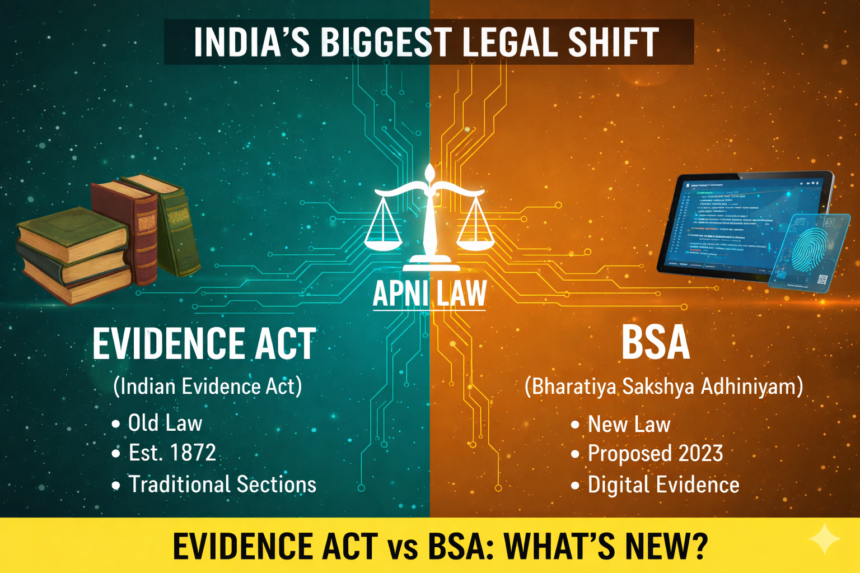
Section 6 of the Indian Evidence Act, 1872, originally codified this principle. The Bharatiya Sakshya Adhiniyam, 2023, retains it under Section 5. The new law preserves both the language and the judicial interpretation of the doctrine.
How Did Section 6 of the Indian Evidence Act Operate?
Section 6 of the Indian Evidence Act treated certain connected facts as relevant even if they were not facts in issue. The provision focused on the idea of a “same transaction.” Courts examined proximity of time, continuity of action, and unity of purpose. If these elements existed, the facts became admissible.
The section admitted spontaneous statements and acts occurring during the event. A cry raised during an assault or words spoken at the moment of injury qualified as part of the transaction. The rule valued immediacy and natural conduct. It rejected statements created after reflection or fabrication.
What Does Section 5 of the Bharatiya Sakshya Adhiniyam Say?
Section 5 of the Bharatiya Sakshya Adhiniyam, 2023, reproduces Section 6 of the Indian Evidence Act almost verbatim. It states that facts not in issue become relevant if they form part of the same transaction as a fact in issue. The legislature made no substantive change to the doctrine.
This continuity ensures legal certainty. Lawyers and judges can rely on decades of precedent. The transition from the old law to the new law remains seamless in this area.
Is There Any Difference Between Section 6 IEA and Section 5 BSA?
There is no substantive difference between the two provisions. Both sections share identical wording and intent. Both focus on the same transaction test. Both rely on judicial interpretation to define scope.
Official comparison tables confirm the direct correspondence. Courts continue to apply established principles without modification. The doctrine retains its flexible and contextual nature under the new statute.
How Do Courts Define “Same Transaction”?
Courts do not define “same transaction” rigidly. They apply a practical and commonsense approach. They examine time proximity, place proximity, continuity of action, and unity of purpose. No single factor is decisive.
If events form a continuous narrative, courts treat them as one transaction. If gaps allow for fabrication or deliberation, courts exclude the facts. The doctrine demands natural and spontaneous linkage.
Why Are Res Gestae Statements Not Treated as Hearsay?
Res Gestae statements bypass the traditional hearsay rule. The law treats them as part of the event itself. Their reliability flows from spontaneity and immediacy. The speaker has no time to fabricate or misrepresent.
Courts focus on contemporaneousness rather than the identity of the speaker. A bystander’s spontaneous exclamation can carry the same weight as a participant’s statement. The factor is the statement’s close connection with the occurrence.
What Role Do Judicial Precedents Play Under the New Law?
Judicial precedents continue to guide interpretation under Section 5 of the BSA. Landmark cases such as Ratten v. R and Gentela Vijayavardhan Rao v. State of Andhra Pradesh remain relevant. These cases clarified the limits of spontaneity and continuity.
Courts still reject statements made after the event ends. They also exclude narratives given after calm reflection. The new law does not dilute these safeguards.
How Does Res Gestae Improve the Truth-Finding Process?
The doctrine prevents fragmented storytelling in court. It allows judges to see events in their natural sequence. It strengthens fact-finding by admitting context, cause, and effect together.
Without this doctrine, courts would miss critical surrounding facts. The law recognizes that human conduct unfolds as a continuous chain. Res Gestae captures that reality.
Does the Bharatiya Sakshya Adhiniyam Expand the Doctrine’s Scope?
The Bharatiya Sakshya Adhiniyam does not expand the doctrine itself. However, it operates in a modern evidentiary framework. The Act recognizes digital and electronic evidence more clearly.
Live-streamed incidents, real-time messages, and instant recordings may now qualify as part of the same transaction. Their admissibility still depends on immediacy and continuity. The doctrine adapts to technology without changing its core principles
Conclusion
Section 5 of the Bharatiya Sakshya Adhiniyam ensures continuity by retaining the doctrine intact. It respects judicial wisdom developed over more than a century. It avoids unnecessary uncertainty during legal transition.
By preserving Res Gestae unchanged, the new law reinforces stability. It confirms that relevance depends on real-life connection, not rigid technicality. The doctrine continues to serve justice under India’s modern evidence law.