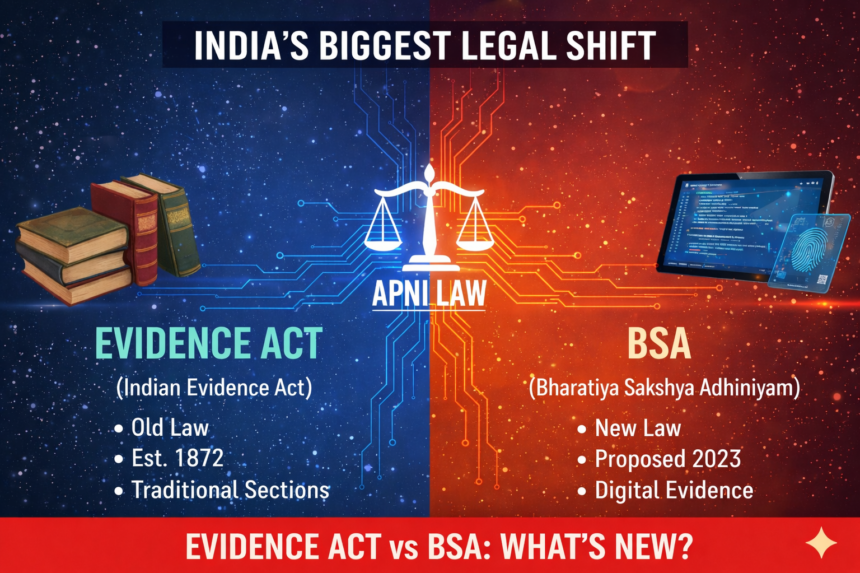
Introduction
Section 5 of the Indian Evidence Act, 1872 lays down the basic rule of relevancy. It restricts evidence strictly to facts in issue and relevant facts. Courts cannot admit evidence beyond these limits. The provision ensures that trials remain focused on real disputes. It prevents unnecessary, confusing, or prejudicial material from entering the record. Evidence must directly prove or disprove a fact in issue or connect to it through relevance defined in law.
How Does Section 5 of the IEA Define Facts in Issue?
Facts in issue are those facts that the court must decide to determine the rights or liabilities of parties. They arise from pleadings in civil cases and charges in criminal cases. If a fact, when proved or disproved, resolves the dispute, it becomes a fact in issue. Section 5 allows evidence only when such facts are contested. Undisputed or legally barred facts remain outside the scope of evidence.
What Are Relevant Facts Under the Indian Evidence Act?
Relevant facts are those facts that relate to facts in issue through logical or legal connections. Sections 6 to 55 of the Indian Evidence Act explain these connections. These include facts forming part of the same transaction, facts showing motive or intention, admissions, confessions, expert opinions, and conduct. Section 5 acts as a gateway. Only facts declared relevant by these later sections can be proved.
What Is the Purpose of Limiting Evidence to Relevant Facts?
The law limits evidence to promote judicial efficiency and fairness. Courts avoid distractions caused by remote or emotional facts. Parties save time and cost. Judges focus on material issues. This restriction also protects individuals from character attacks or speculative allegations. Section 5 therefore supports speedy trials and reasoned judgments.
How Does Section 4 of the Bharatiya Sakshya Adhiniyam Define Facts in Issue?
Section 4(1) of the Bharatiya Sakshya Adhiniyam, 2023 defines “facts in issue” in the same manner as Section 3 of the Indian Evidence Act. The definition remains unchanged in substance. Facts in issue continue to mean facts asserted by one party and denied by the other. The basic test of direct connection with the dispute stays intact.
How Does Section 4 of the BSA Define Relevant Facts?
Section 4(2) of the BSA defines a relevant fact as a fact made relevant by the provisions of the Act. This mirrors the structure of the Indian Evidence Act. Chapter II of the BSA, covering Sections 6 to 53, explains relevancy in detail. The conceptual framework remains the same. Relevance depends on statutory recognition, not judicial discretion alone.
Does the BSA Change the Scope of Admissible Evidence?
The BSA does not expand admissibility in substance. It retains the same limitation as Section 5 of the Indian Evidence Act. Evidence remains confined to facts in issue and relevant facts. The principle of exclusion of extraneous evidence continues. Courts still reject evidence that does not meet statutory relevance.
What Is the Major Difference Between IEA and BSA on Relevancy?
The key difference lies in explicit recognition of electronic and digital records. The BSA integrates digital evidence directly into its definitions. It aligns relevancy with modern forms of communication and data. Emails, server logs, metadata, and digital footprints now fit naturally within the relevancy framework. The Indian Evidence Act relied heavily on judicial interpretation, especially through Section 65B, to address this gap.
Does Digital Inclusion Change the Relevancy Test?
Digital inclusion does not change the relevancy test itself. The test still asks whether the fact helps prove or disprove a fact in issue. The change only modernizes the medium of proof. The logic of connection remains unchanged. Courts still apply Sections 6 to 53 of the BSA to assess relevance.
How Do Illustrations Under Section 5 Apply Under the BSA?
Illustrations used under Section 5 of the Indian Evidence Act remain conceptually valid. For example, in a murder trial, evidence must relate to the act, intention, cause of death, or identity of the accused. Facts unrelated to these issues remain inadmissible. The same reasoning applies under the BSA, even when evidence appears in digital form.
Does the BSA Remove Any Safeguards Present in the IEA?
The BSA does not remove safeguards. It preserves the exclusion of irrelevant facts. It continues to respect procedural bars imposed by civil and criminal procedure laws. Evidence that is legally barred or irrelevant remains inadmissible. The balance between truth-finding and fairness remains intact.
Why Is Section 4 BSA Considered a Continuation, Not a Replacement?
Section 4 of the BSA continues the philosophy of the Indian Evidence Act. It updates language and technology references. It does not alter foundational principles. The shift reflects evolution, not disruption. Courts can transition smoothly without re-learning relevancy rules.
What Is the Overall Impact of the Shift From IEA to BSA?
The overall impact is modernization without doctrinal change. Relevancy remains the backbone of evidence law. Facts in issue and relevant facts continue to control admissibility. The BSA ensures that the law stays effective in a digital age. At the same time, it preserves the clarity and discipline established in 1872.
How Should Students and Practitioners Understand This Comparison?
The focus should remain on identifying facts in issue first. Relevance should then be tested through statutory provisions. Digital evidence should be analyzed using the same logical framework. This approach ensures accurate application of the new law.
Conclusion
The principle of relevancy has not changed. Only its expression has evolved. Section 5 of the Indian Evidence Act and Section 4 of the Bharatiya Sakshya Adhiniyam serve the same purpose. Both protect the integrity of judicial proceedings. Both ensure that only meaningful facts reach the court. The law moves forward, but its foundation remains firm.