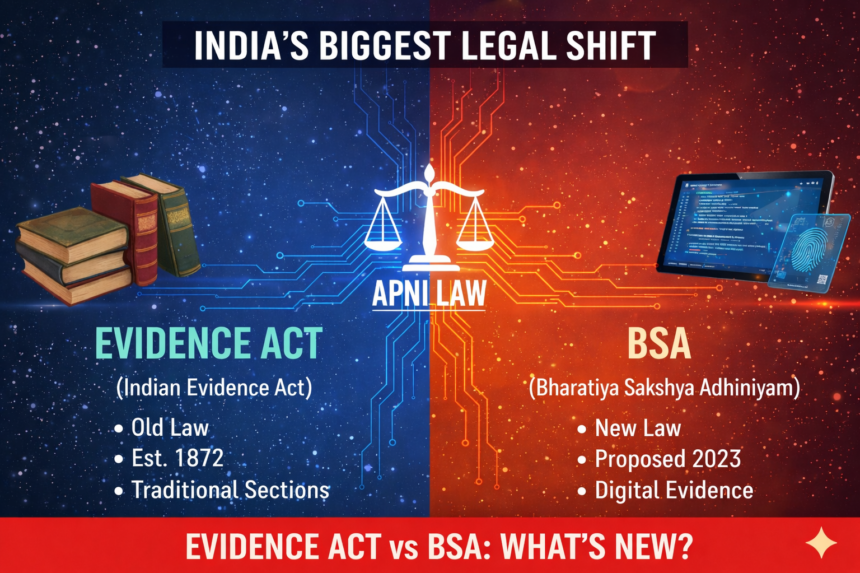
Introduction
Indian criminal law treats custodial confessions with extreme caution. The law presumes a risk of pressure, threat, or inducement when the police control the accused. To prevent abuse, the law bars the use of such confessions unless strict safeguards apply. Section 26 of the Indian Evidence Act, 1872, and its successor, Section 24 of the Bharatiya Sakshya Adhiniyam, 2023 (BSA), enforce this protection. Both provisions ensure that courts rely only on voluntary and judicially supervised confessions.
Why Did the Law Create Special Protection for Custodial Confessions?
The legislature recognized the imbalance of power between the police and an accused person in custody. Custody creates vulnerability. The risk of coercion increases behind closed doors. The law therefore steps in to protect personal liberty and fair trial rights. Sections 26 and 24 strengthen the earlier bar on police confessions found in Sections 25 of the Evidence Act and 23 of the BSA. These provisions target the setting of custody itself, not merely the person to whom the confession is made.
What Does Section 26 of the Indian Evidence Act Say?
Section 26 clearly states that a confession made while a person is in police custody cannot be proved against that person. The law allows only one exception. The accused must make the confession in the immediate presence of a Magistrate. This rule applies even if the accused speaks to a private individual while in custody. The focus remains on custody, not on the listener.
The section works alongside Section 25. Section 25 bars confessions made to police officers. Section 26 extends the bar to all confessions made during custody. Together, they close possible loopholes and prevent indirect coercion.
Who Qualifies as a Magistrate Under Section 26?
Courts interpret the word “Magistrate” strictly. Only a Judicial Magistrate or Metropolitan Magistrate qualifies. Executive Magistrates, village officers, or administrative authorities do not meet this standard. The law demands judicial independence. A Magistrate provides neutrality and legal oversight. This requirement ensures that the accused speaks freely and understands the consequences of confession.
What Does “Immediate Presence of a Magistrate” Mean?
The phrase “immediate presence” carries legal weight. Courts require physical proximity and active supervision. The Magistrate must be close enough to observe and control the environment. Mere availability or remote supervision does not suffice. This interpretation ensures that police influence remains absent. Judicial presence must be real and effective.
How Does Section 27 Fit into the Custodial Confession Framework?
Section 27 of the Evidence Act creates a limited exception. It allows the court to admit facts discovered as a result of information given by the accused while in custody. This rule does not validate the entire confession. It admits only the portion that leads directly to discovery of a material fact. The logic rests on reliability through verification. This exception survives under the BSA as well.
What Does Section 24 of the Bharatiya Sakshya Adhiniyam, 2023 Provide?
Section 24 of the BSA replaces Section 26 of the Evidence Act. The wording remains almost identical. The substance does not change. The law still bars custodial confessions unless made in the immediate presence of a Magistrate. The BSA came into force on July 1, 2024. It consolidates and modernizes evidentiary rules without diluting safeguards.
The continuity shows legislative intent. Parliament chose stability over experimentation in custodial confession law. Courts therefore continue to rely on established judicial precedents.
How Does Section 24 of the BSA Differ From Section 23?
Section 23 of the BSA deals with confessions made to police officers. Section 24 focuses solely on custody. Even if the accused speaks to a non-police person, the bar applies as long as custody exists. This separation clarifies the legal framework. It avoids confusion between the role of the listener and the setting of the confession.
Does the BSA Change the Test of Voluntariness?
The BSA does not alter the core test of voluntariness. Courts still examine the mental state of the accused. They look for threats, inducements, or promises. Judicial scrutiny remains strict. Precedents interpreting “immediate presence” and voluntariness under the Evidence Act continue to apply under the BSA.
Are the Two Provisions Substantively Different?
No substantive difference exists. Section 26 of the Evidence Act and Section 24 of the BSA operate in the same manner. Both protect accused persons from coercive custodial practices. Both insist on judicial supervision. Both preserve the limited discovery exception. The shift from the Evidence Act to the BSA represents reform in structure, not in principle.
Why Do Courts Continue to Rely on Earlier Case Law?
Legal continuity demands consistency. Since the language remains unchanged, judicial interpretation also remains relevant. Courts continue to cite earlier rulings on Magistrate presence and custody. This approach ensures predictability and fairness in criminal trials.
Conclusion
Section 26 of the Evidence Act and Section 24 of the BSA reflect the heart of criminal due process. They protect dignity, liberty, and fairness. The BSA preserves this protection without dilution. Custodial confessions remain inadmissible unless made under strict judicial supervision. The law sends a clear message. Truth must come from fairness, not force.