Introduction
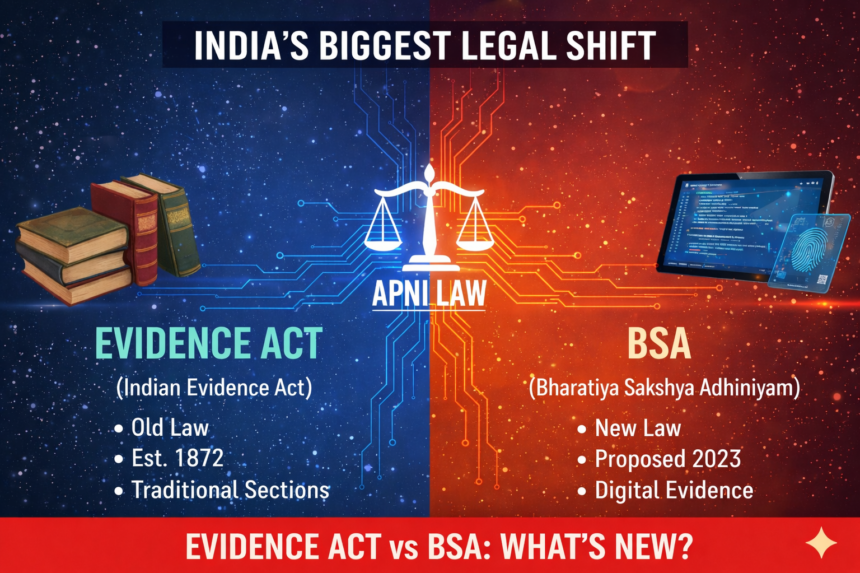
Section 10 of the Indian Evidence Act, 1872 deals with the admissibility of acts, statements, and writings of co-conspirators. It makes such acts relevant against all members of a conspiracy when they relate to a common design. The Bharatiya Sakshya Adhiniyam, 2023 replaces the Indian Evidence Act and introduces Section 8 as the corresponding provision. Section 8 of the BSA reproduces Section 10 of the IEA word for word. There is no substantive or conceptual change between the two laws. The legislature has consciously retained the same legal position on conspiracy evidence.
What Is the Legal Principle Behind These Provisions?
Both Section 10 of the IEA and Section 8 of the BSA operate on the principle of agency. Each conspirator acts as an agent of the others during the subsistence of the conspiracy. When one conspirator speaks or acts in furtherance of the common intention, the law treats it as the act of all. This principle allows courts to attribute collective responsibility for actions taken to advance the conspiracy.
What Does the Exact Wording of the Law Provide?
Section 10 of the Indian Evidence Act states that when there is reasonable ground to believe that two or more persons have conspired to commit an offence or an actionable wrong, anything said, done, or written by any one of them in reference to their common intention becomes a relevant fact against all conspirators. Section 8 of the Bharatiya Sakshya Adhiniyam uses the exact same language. The illustrations accompanying the sections are also unchanged. This shows legislative continuity and confirms that earlier judicial interpretations remain applicable.
What Is the Threshold for Admitting Conspiracy Evidence?
The law requires the court to find reasonable grounds to believe that a conspiracy exists. This threshold is crucial. Courts cannot rely solely on the statements of co-conspirators to establish the conspiracy. Independent and prima facie evidence must first suggest the existence of a conspiracy. Only after this condition is satisfied can acts or statements of co-conspirators be admitted against others.
What Kind of Acts and Statements Become Relevant?
The provisions cover anything said, done, or written by a conspirator in reference to the common intention. These acts must have a direct nexus with the object of the conspiracy. Statements made casually or acts unrelated to the common design do not qualify. The law focuses on conduct that furthers or explains the conspiracy. This ensures that relevance is tied strictly to the shared criminal or wrongful purpose.
During What Period Does This Rule Apply?
The admissibility rule applies only while the conspiracy is ongoing. Acts or statements made after the conspiracy has ended fall outside the scope of Section 10 IEA and Section 8 BSA. Termination may occur when the object is achieved, abandoned, or rendered impossible. Courts consistently exclude post-conspiracy confessions or narratives unless they independently qualify under another provision of evidence law.
What Role Do Illustrations Play Under Both Laws?
The illustrations under both sections remain identical. They include examples such as procurement of arms, collection of funds, or circulation of writings to promote the conspiracy. These illustrations clarify how acts of one conspirator can be used against others. Their retention under the BSA confirms that Parliament intended no deviation from established principles.
How Have Courts Interpreted These Provisions?
Indian courts have interpreted Section 10 of the IEA strictly and cautiously. Landmark judgments such as Mirza Akbar v. King Emperor emphasize that the conspiracy must be independently proved before co-conspirator statements become relevant. Courts also stress the requirement of a clear link between the act or statement and the common design. These judicial principles continue to govern Section 8 of the BSA.
Does Section 8 of the BSA Introduce Any Change in Law?
Section 8 of the Bharatiya Sakshya Adhiniyam does not introduce any substantive change. The text, scope, illustrations, and legal effect remain the same as Section 10 of the Indian Evidence Act.
What Is the Practical Importance of These Sections?
These provisions play a critical role in prosecuting conspiracy cases. Direct evidence of conspiracy is rare. Section 10 IEA and Section 8 BSA allow courts to infer collective intent from coordinated actions. They help establish participation and continuity of design. At the same time, safeguards like the requirement of independent proof prevent misuse.
How Do These Provisions Affect Criminal Trials Today?
In modern trials, especially those involving organized crime, terrorism, or economic offences, conspiracy evidence is central. Section 8 of the BSA ensures that investigative and prosecutorial strategies remain unchanged after the repeal of the IEA. Courts continue to apply the same standards of admissibility, relevance, and caution.
Conclusion
Section 10 of the Indian Evidence Act and Section 8 of the Bharatiya Sakshya Adhiniyam are legally identical. Both reflect the same philosophy, wording, and judicial understanding of conspiracy evidence. The BSA preserves established doctrine rather than reforming it. This ensures continuity, predictability, and stability in the law of evidence relating to conspiracies.