Introduction
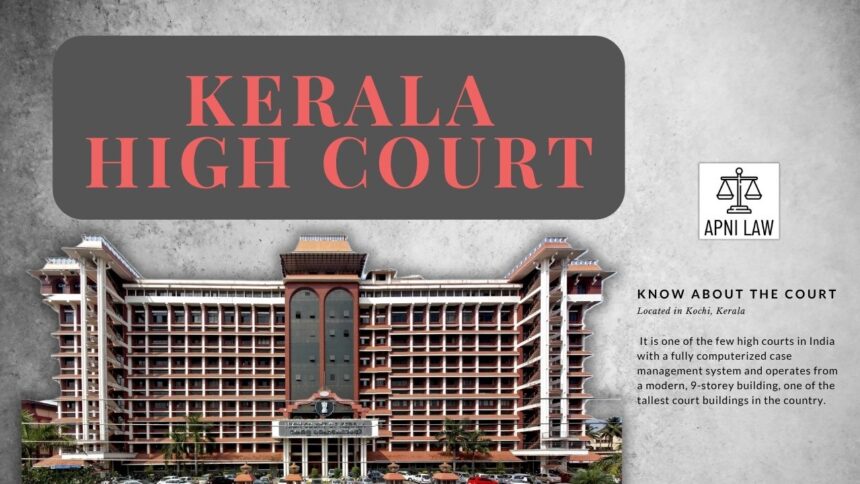
The Kerala High Court has ruled that the mere presence of alcohol in a deceased person’s body is not enough to deny an insurance claim. The Court held that an insurer must prove that the insured was actually “under the influence of alcohol” at the time of the accident, as required under the insurance policy.
While dismissing a challenge by the insurance company, the Court also held that an accident can still be considered the proximate cause of death even if the deceased had a pre-existing heart condition, provided the accident accelerated or contributed to the death.
Case Background
The case arose after Babu, the insured, met with a motorcycle accident and later died while undergoing treatment in the hospital.
His legal heirs filed a claim under the insurance policy before the Permanent Lok Adalat, which awarded them ₹15 lakh as compensation.
Challenging this award, United India Insurance Company approached the Kerala High Court.
The insurer argued that the deceased’s toxicology report showed the presence of alcohol and that the post-mortem report mentioned occlusive coronary artery disease as the cause of death. Based on these findings, the insurer contended that the claim was excluded under the policy.
Insurance Company’s Arguments
The insurance company submitted that the toxicology report confirmed the presence of alcohol in the deceased’s body. It also relied on the post-mortem report, which identified coronary artery disease as the cause of death.
According to the insurer, these facts disentitled the legal heirs from receiving insurance benefits.
High Court’s Observations
The High Court rejected the insurer’s arguments and drew a clear distinction between consuming alcohol and being under the influence of alcohol.
The Court observed that the toxicology report merely established the presence of alcohol but did not prove that the deceased’s mental or physical faculties were impaired at the time of the accident.
The Court held that a positive toxicology report alone cannot attract the exclusion clause in an insurance policy. To deny a claim, the insurer must establish, through evidence, that the deceased was actually under the influence of alcohol when the accident occurred.
Relying on the decisions in Oriental Insurance Co. Ltd. v. Vineetha Nair and IFFCO Tokio General Insurance Co. Ltd. v. Pearl Beverages Ltd., the Court reiterated that the insurer must prove the circumstances surrounding the accident, including the extent of alcohol consumption and its effect on the insured’s ability to drive.
Since no such evidence was produced in the present case, the Court held that the policy exclusion could not be invoked.
Accident Was the Proximate Cause of Death
The Court also examined whether the death could still be treated as accidental despite the post-mortem report mentioning coronary artery disease.
It noted that the same post-mortem report specifically stated that the injuries sustained in the accident could have accelerated or precipitated the death. The report also recorded multiple injuries suffered by the deceased.
Referring to the Supreme Court’s decision in Alka Shukla v. LIC of India, the Court held that accident benefit claims require a proximate causal connection between the accident, the injuries, and the death.
After considering the medical evidence as a whole, the Court concluded that the accident had a direct and substantial connection with the deceased’s death.
Final Verdict
The Kerala High Court dismissed the insurance company’s writ petition and upheld the award of ₹15 lakh granted by the Permanent Lok Adalat to the deceased policyholder’s legal heirs.
The Court clarified that the mere detection of alcohol in a toxicology report cannot defeat an insurance claim unless the insurer proves that the insured was actually under the influence of alcohol. It further held that where an accident accelerates or contributes to death, the claim cannot be denied merely because the deceased also suffered from a pre-existing medical condition.
Case Title: United India Insurance Company Co. Ltd. v. Salpriya and Others