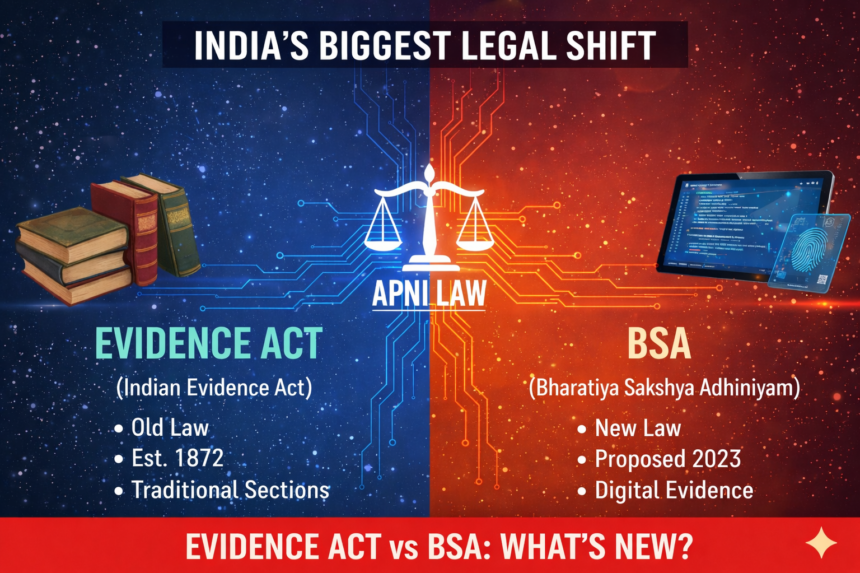
Introduction
Section 3 of the Indian Evidence Act, 1872 defines the meaning of evidence for Indian courts. It limits evidence to two main forms. The first form is oral evidence. This includes statements made by witnesses before the court. These statements must relate directly to the facts under inquiry. The second form is documentary evidence. This includes documents produced for the court’s inspection. The original provision later included electronic records through judicial interpretation and amendments, but the language remained rooted in a paper-based legal system. The definition reflects the legal needs of the nineteenth century. It focuses on physical presence and tangible records.
Why Was There a Need to Redefine Evidence in the Bharatiya Sakshya Adhiniyam, 2023?
The justice system has changed due to technology. Communication now happens through emails, video calls, digital platforms, and servers. Crimes also occur in virtual spaces. The old framework did not clearly recognize electronic modes of testimony and proof. Courts relied on interpretation to admit such material. This created inconsistency and delay. The Bharatiya Sakshya Adhiniyam, 2023 responds to this gap. It updates the law to reflect modern realities. It removes ambiguity by expressly including electronic and digital forms of evidence.
How Does Section 2(1)(e) of the BSA Define Evidence?
Section 2(1)(e) of the Bharatiya Sakshya Adhiniyam, 2023 provides a modern definition of evidence. It retains the basic structure of the earlier law. However, it expands the scope in clear terms. Oral evidence now includes statements given electronically. Documentary evidence now includes electronic and digital records. The court can accept such material without stretching interpretation. The definition directly acknowledges digital communication as a normal mode of proof.
How Is Oral Evidence Expanded Under the BSA?
The BSA explicitly includes statements given electronically as oral evidence. This is a major shift. A witness no longer needs to be physically present in court. The court can record testimony through video conferencing or other electronic means. This aligns with procedural laws that allow remote examination of witnesses. It improves access to justice. It also saves time and cost. Electronic oral evidence now stands on equal footing with in-person testimony.
How Is Documentary Evidence Broadened Under the BSA?
Under the Indian Evidence Act, documentary evidence included documents and electronic records. The BSA goes further. It uses the phrase “electronic or digital records.” This change is subtle but important. It highlights the wide range of modern data formats. These include emails, text messages, cloud files, server logs, metadata, and location data. The law now clearly recognizes such material as documentary evidence. Courts can rely on digital footprints with greater confidence.
Does the Core Structure of the Definition Change?
The core structure of the definition remains the same. Evidence still consists of oral and documentary forms. The court still controls admissibility. What changes is the clarity of inclusion. The BSA modernizes the language without altering the foundation. It ensures continuity while embracing technology. This balance helps courts transition smoothly from the old regime to the new one.
What Practical Impact Does This Expansion Have on Court Proceedings?
The expansion has a direct impact on daily court functioning. Courts can now accept electronic testimony without hesitation. Video and audio statements can serve as oral evidence. Digital records can be examined as primary proof. This is especially useful in cybercrime cases. It also helps in commercial disputes and cross-border matters. The process becomes faster and more efficient. The justice system becomes more accessible and responsive.
How Does the BSA Support Remote and Digital Justice?
The inclusion of electronic statements supports remote justice mechanisms. Courts can examine witnesses who are unable to attend physically. This is useful in cases involving distance, security, or health concerns. It also supports paperless courts. Digital filing and digital proof work together under the new framework. The law now supports a technology-driven justice system.
Does the BSA Have a Wider Application Than the IEA?
The Bharatiya Sakshya Adhiniyam applies uniformly across India. It also extends to courts-martial and other adjudicatory bodies where applicable. The Indian Evidence Act had limited exclusions and older structural constraints. The new law aims for uniformity and clarity. It strengthens the evidentiary framework across forums.
Conclusion
The new definition reflects legal modernization. It aligns law with technology. It reduces ambiguity and judicial burden. It recognizes electronic reality as legal reality. By expanding the scope of evidence, the BSA ensures that justice keeps pace with change. It preserves the essence of evidence law while preparing it for the future.