


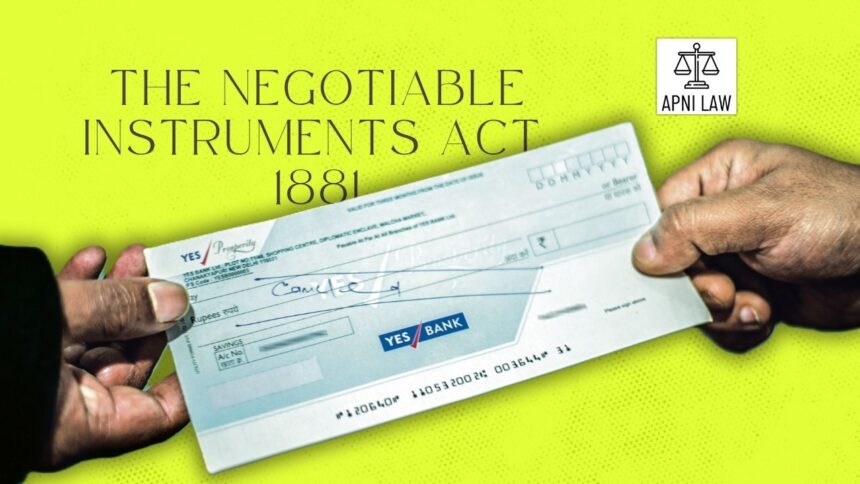
Court clarifies that failure to reflect part payments on cheque defeats prosecution under cheque dishonour law.
Court, Bench and Date of Judgment
The Supreme Court of India delivered the judgment in 2022 (reported subsequently), clarifying the scope of Section 138 of the Negotiable Instruments Act, 1881 in cases involving part payments made before cheque presentation.
Legal Issue
The central issue before the Court was:
- Whether an offence under Section 138 NI Act is made out when a cheque is presented for the entire amount, despite the borrower having already made part payments, and such payments are not endorsed on the cheque.
Case Background
The dispute arose from a financial transaction where the borrower had issued a cheque to discharge a debt. However, before the cheque was presented for encashment, the borrower had already made partial repayment of the outstanding amount.
Despite this, the cheque was presented for the full original amount, without recording or endorsing the part payment. The cheque was subsequently dishonoured, leading to criminal proceedings under Section 138 of the NI Act.
Lower courts examined whether such prosecution could be sustained when the actual legally enforceable debt had reduced due to part payment.
Petitioner’s Stance
The complainant argued that:
- The cheque represented a legally enforceable liability.
- Dishonour of the cheque for the full amount triggered Section 138.
- The existence of part payment did not negate the offence.
The complainant sought continuation of criminal proceedings based on the dishonoured cheque.
Court’s Reasoning
The Supreme Court held that strict compliance with statutory requirements under Section 138 is essential.
The Court reasoned as follows:
- Section 138 applies only when the cheque represents a legally enforceable debt or liability at the time of presentation.
- If part payment has already been made, the actual liability stands reduced.
- In such cases, the cheque must reflect the correct outstanding amount, either through endorsement or adjustment.
- Presenting a cheque for the full amount without acknowledging part payment misrepresents the legally enforceable debt.
The Court emphasized that failure to endorse part payment on the cheque results in a mismatch between the cheque amount and the subsisting liability, which is fatal to prosecution under Section 138.
It further clarified that:
- Criminal liability under Section 138 is strict and technical in nature.
- Any deviation from statutory requirements, including incorrect quantification of debt, can invalidate the complaint.
This interpretation aligns with prior rulings stressing that the demand must correspond exactly to the legally enforceable amount.
Final Ruling
The Supreme Court held that:
- No offence under Section 138 NI Act is made out if a cheque is presented for the full amount without endorsing part payment already made by the borrower.
- Such prosecution is legally unsustainable as the cheque does not represent the true outstanding liability.
Practical Implications
This ruling has significant implications for cheque dishonour litigation:
- Accuracy of liability is crucial: Creditors must ensure that the cheque reflects the actual outstanding amount after accounting for part payments.
- Endorsement requirement: Any part payment made before presentation must be properly recorded or endorsed on the cheque or otherwise reflected in the claim.
- Defence for accused: Borrowers can rely on proof of part payment to challenge prosecution if the cheque amount is inflated.
- Strict compliance standard: Courts will continue to apply a technical and strict interpretation of Section 138 requirements.
The decision reinforces that Section 138 proceedings are not merely about dishonour of a cheque, but about dishonour of a cheque representing a legally enforceable and correctly quantified debt.
Conclusion
The judgment adds clarity on the requirement that a cheque must correspond to the actual legally enforceable liability at the time of presentation, and that failure to account for part payments can invalidate prosecution under Section 138 of the NI Act.




