Introduction
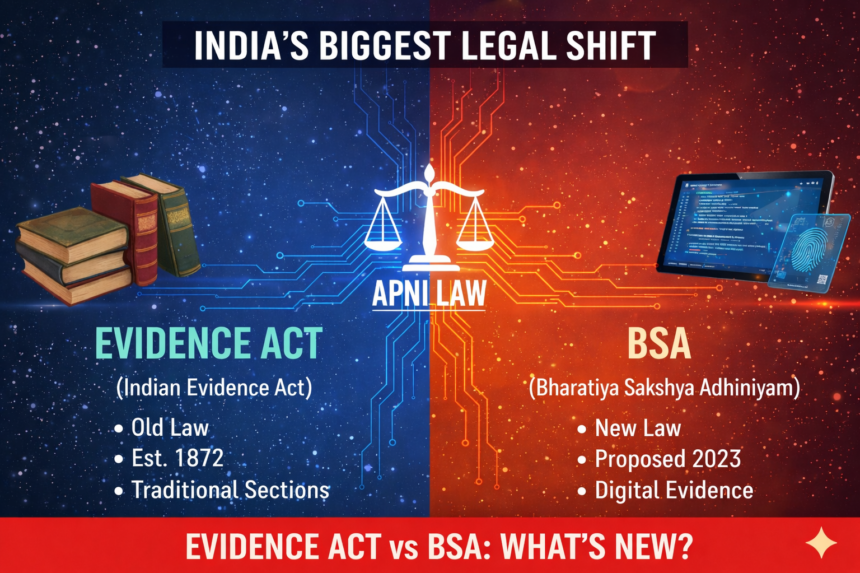
Indian evidence law has evolved to address both physical and digital forms of proof. Section 73 of the Indian Evidence Act, 1872, and Section 66 of the Bharatiya Sakshya Adhiniyam, 2023 (BSA), deal with the authentication of signatures. However, they operate in entirely different legal environments. One governs handwritten and physical signatures, while the other regulates electronic signatures used in digital records. Understanding this distinction is essential in the era of digitised litigation and electronic evidence.
What Is the Purpose of Section 73 of the Indian Evidence Act?
Section 73 of the Indian Evidence Act empowers courts to compare disputed signatures, handwriting, or seals with admitted or proven specimens. The court itself may undertake this comparison. It may also direct a person present before it to write words or affix a signature for the purpose of comparison. The provision does not require expert opinion as a mandatory prerequisite. Instead, it places confidence in judicial observation, subject to caution laid down by courts.
This section applies only when the specimen used for comparison is admitted or undisputed. Courts have consistently held that disputed documents cannot be compared with other disputed writings. Section 73 thus facilitates direct judicial scrutiny of physical evidence in a controlled courtroom environment.
How Does Section 66 of the Bharatiya Sakshya Adhiniyam Function?
Section 66 of the Bharatiya Sakshya Adhiniyam, 2023, deals exclusively with electronic signatures. It governs the proof of authenticity of electronic records signed digitally. Unlike Section 73 of the Evidence Act, this provision does not authorise the court to visually compare signatures. Instead, it places the burden of proof on the party relying on the electronic signature.
If the electronic signature is not a secure electronic signature, the relying party must prove that the signature belongs to the alleged subscriber. This proof may come through system logs, digital certificates, audit trails, or other technical evidence. However, when the law recognises the electronic signature as secure, Section 66 creates a statutory presumption of authenticity.
Why Is Court Comparison Central to Section 73 but Absent in Section 66?
The difference arises from the nature of the evidence involved. Physical signatures and handwriting allow visual comparison. Judges can examine stroke patterns, letter formations, and writing habits. Section 73 therefore authorises courts to directly engage with the evidence.
Electronic signatures function differently. They rely on cryptographic systems, private keys, and certification authorities. A judge cannot visually inspect a digital signature for authenticity. Section 66 accordingly removes the court from the technical verification process and relies on documentary and electronic proof produced by the parties.
What Is the Role of Presumptions Under Both Provisions?
Section 73 of the Evidence Act does not provide any statutory presumption. The court must reach its own satisfaction after comparison. Judicial precedents caution against excessive reliance on personal comparison without expert assistance, especially in complex cases.
Section 66 of the BSA, on the other hand, introduces a strong legal presumption in favour of secure electronic signatures. Once a signature qualifies as secure under the Information Technology Act framework, the court presumes it to be genuine unless disproved. This presumption significantly reduces the evidentiary burden in digital transactions.
How Has the Bharatiya Sakshya Adhiniyam Retained Section 73’s Core Principle?
The Bharatiya Sakshya Adhiniyam does not discard the traditional rule. It reenacts Section 73 of the Evidence Act as Section 72 of the BSA for physical signatures and handwriting. This ensures continuity in evidentiary principles for non-digital documents.
At the same time, the BSA expands the framework for electronic evidence. Section 66 modernises proof relating to electronic signatures, while Section 73 of the BSA separately deals with verification of digital signatures using public key infrastructure and digital certificates. Together, these provisions create a comprehensive digital evidence regime.
How Does Section 66 Reflect the Digital Shift in Evidence Law?
Section 66 reflects India’s transition toward electronic governance and paperless transactions. It aligns evidentiary standards with the Information Technology Act. The provision recognises that authenticity in the digital world depends on system integrity rather than human handwriting.
By shifting the burden of proof to the relying party and recognising secure electronic signatures, Section 66 promotes trust in digital commerce, e-filing, and online contracts. It also reduces unnecessary technical disputes when statutory safeguards already exist.
What Are the Key Legal Differences Between Section 73 and Section 66?
Section 73 governs tangible evidence. Section 66 governs intangible digital authentication. One empowers judicial comparison. The other depends on technological verification. One operates without presumptions. The other creates statutory presumptions for secure signatures.
Most importantly, Section 73 relies on human observation. Section 66 relies on cryptographic certainty. This distinction defines the boundary between traditional and modern evidence law in India.
Conclusion
Section 73 of the Evidence Act and Section 66 of the Bharatiya Sakshya Adhiniyam serve different but complementary purposes. One anchors the law in traditional proof mechanisms. The other prepares the judiciary for a digital future. Together, they represent the evolution of Indian evidence law from ink and paper to encryption and algorithms.