Introduction
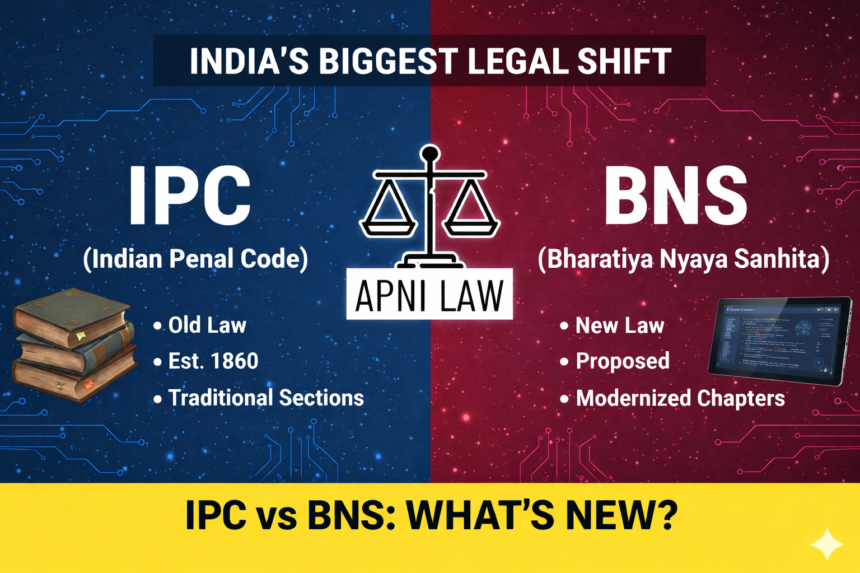
Criminal conspiracy has always occupied a unique place in Indian criminal law. Unlike most offences, conspiracy focuses not on the final act but on the agreement to commit an unlawful act. With the introduction of the Bharatiya Nyaya Sanhita, 2023, Section 108 replaces the long-standing Section 120B of the Indian Penal Code. While the core idea remains familiar, the new provision reflects a modern legislative approach aimed at clarity, consistency, and alignment with contemporary criminal justice needs.
This article explains how Section 108 of the BNS compares with Section 120B of the IPC, highlighting continuity as well as meaningful legal shifts.
What is Criminal Conspiracy Under Section 120B IPC?
Section 120B of the IPC punishes criminal conspiracy as defined under Section 120A. A criminal conspiracy exists when two or more persons agree to do an illegal act or a legal act by illegal means. The law does not require the actual commission of the offence. The agreement itself completes the crime.
Courts have consistently held that conspiracy is usually proved through circumstantial evidence because direct proof of agreement is rare. As a result, conduct before, during, and after the alleged offence often plays a decisive role. Punishment under Section 120B depends on the gravity of the offence that is the object of the conspiracy. If the conspiracy involves a serious offence, the punishment mirrors that offence. In other cases, imprisonment may extend up to six months, along with fine.
How Does Section 108 BNS Define Criminal Conspiracy?
Section 108 of the Bharatiya Nyaya Sanhita retains the foundational structure of criminal conspiracy. It continues to criminalise the agreement between two or more persons to commit an offence or to achieve a lawful objective through unlawful means. The offence still focuses on intention and consensus rather than execution.
However, the drafting under BNS uses clearer and more contemporary language. The provision avoids unnecessary complexity while preserving judicial interpretations developed over decades. By doing so, it ensures continuity while making the law more accessible to investigators, lawyers, and courts alike.
Is an Overt Act Required to Prove Conspiracy?
Both Section 120B IPC and Section 108 BNS maintain that an overt act is not mandatory when the conspiracy relates to a serious offence. The agreement itself suffices to constitute the offence. However, when the conspiracy involves a lawful act carried out through illegal means, some act in furtherance of the agreement becomes relevant.
This principle remains unchanged under the BNS. As a result, the evidentiary standards developed by Indian courts continue to apply, ensuring stability in criminal jurisprudence.
How Does Punishment Under BNS Compare With IPC?
Punishment under Section 120B IPC varies depending on the nature of the conspiracy. The same approach continues under Section 108 BNS. When the conspiracy targets a grave offence, punishment aligns with that offence. In other cases, the law provides for imprisonment or fine.
The BNS aims to streamline punishment provisions across offences. Therefore, while the quantum of punishment may not differ significantly, the structural clarity improves sentencing consistency. This change supports uniform application without altering the substantive rights of the accused.
What Changes Does the BNS Introduce in Practical Terms?
The most significant change lies not in substance but in legislative intent. The Bharatiya Nyaya Sanhita seeks to modernise criminal law without disrupting settled principles. Section 108 reflects this balance. It simplifies language, integrates the offence within a restructured code, and aligns conspiracy provisions with other inchoate offences.
Additionally, the BNS framework emphasises procedural efficiency and victim-centric justice. Although conspiracy remains an offence against public order and state authority, its treatment under the BNS fits into a broader reform-oriented vision.
Why Is Criminal Conspiracy Still Relevant Today?
In an era of organised crime, financial fraud, terrorism, and cyber offences, conspiracy laws play a critical role. Many complex crimes involve planning by multiple actors who operate behind the scenes. Section 108 BNS ensures that the law continues to address collective criminal intent effectively.
At the same time, courts remain cautious. Mere association or knowledge does not amount to conspiracy. The prosecution must establish a meeting of minds. This safeguard protects individual liberty while enabling accountability.
Conclusion
Section 108 of the Bharatiya Nyaya Sanhita largely preserves the essence of Section 120B of the IPC while presenting it in a clearer and more structured form. The offence of criminal conspiracy remains rooted in the concept of agreement and shared intention. Although the language has evolved, the legal principles, evidentiary standards, and judicial safeguards remain intact.
For students, practitioners, and anyone tracking India’s criminal law reforms, this comparison highlights how the BNS builds upon existing jurisprudence rather than discarding it. Criminal conspiracy continues to be a powerful yet carefully regulated tool within India’s criminal justice system.